Yale Law admits 6% of applicants. The 250-word essay is the primary differentiator. Here is the framework, score bands, and templates that produce competitive files.
Introduction Yale Law School is widely regarded as the most prestigious law school in the United States, known for its elite academic culture, exceptionally small class sizes, and unmatched placement into judicial clerkships, academia, public interest, and top legal roles worldwide.
TUITION
$72,000
ACCEPTANCE RATE
5%
CLASS SIZE
200
MEDIAN LSAT
175
MEDIAN GPA
3.96
How to Get Into Yale Law School
Yale Law School is the most selective law school in the country. Six percent of applicants are admitted. The entering class has fewer than 200 students. The median LSAT is 174.
Two common applicant profiles:
Example A (strong stats, generic application): 3.96 GPA + 175 LSAT → you are above median on both dimensions. You will be rejected if your 250-word essay summarizes your background rather than demonstrating intellectual engagement. At Yale, stats above the median are expected. What the committee is actually reading is the 250-word essay.
Example B (strong everything except the essay): 3.90 GPA + 173 LSAT + compelling work history + a 250-word essay that describes why you find criminal procedure interesting → you will likely be waitlisted. The description of interest is not a demonstration of intellectual engagement. Yale requires the latter.
Here is what a finished Yale-ready application looks like before you write a single new sentence: your LSAT is at or above 172, your personal statement makes a clear argument about who you are and what you intend to do, and your 250-word essay demonstrates how you actually think about a specific idea—not what you care about in general.
That outcome is a portfolio decision. At Yale, the 250-word essay is the highest-leverage component for applicants in the competitive LSAT range. Most applicants write the wrong essay. This guide shows you how to write the right one.
FEATURED SNIPPET
To get into Yale Law, your LSAT needs to be at or above 172, and your 250-word supplemental essay must demonstrate intellectual engagement with a specific idea—not summarize your interests. Yale evaluates intellectual vitality above all other qualitative factors. The personal statement and 250-word essay work together as an argument.
Your Yale Scorecard
RULE
Yale’s 250-word essay is the primary differentiator in the competitive LSAT range. Most applicants write a summary of their interests. The applicants who get in write a demonstration of how their mind works. These are different products requiring different strategies.
Who This Is For
You want a systematic approach to Yale, including a specific 250-word essay framework.
You are in the 172–176 LSAT range and are not sure whether your essays are doing the right job.
You are a KJD with strong academic work and are building the intellectual demonstration case.
You are a working professional with documented intellectual or policy work and need a framework for the 250-word essay.
You are deciding between Yale and Harvard or Columbia and need a clear strategic differentiation.
Not for you if: your LSAT is below 170 and you have no plan to address it, or you want a shortcut around the essays.
By the end, you will have: a Yale-specific selection logic map, score bands and compensation strategy, a 250-word essay framework with three structural approaches, templates for every application component, and a KPI dashboard.
Setup: Yale Law in Numbers
The 6% acceptance rate is structural: Yale admits roughly 200 students from roughly 4,000 applications. At that ratio, every seat is individually scrutinized. Harvard can absorb statistical variance because it admits 560 students. Yale cannot.
RULE
Because Yale’s class is so small, the committee cannot use statistical shortcuts. Every file is read closely, and every file needs a reason to take one of 200 seats. Your 250-word essay is the primary evidence for that reason.
What Yale Is Actually Selecting For
Yale has been explicit in its public communications about what it evaluates. Three factors:
Intellectual vitality: evidence that you engage with ideas because you are constitutionally unable to stop, not because intellectual engagement is a credential.
Professional distinction: a record that shows you have done something that matters, with measurable effect.
Clear sense of purpose: a specific, argued account of what you plan to do with a Yale degree—not a general aspiration, but a named problem with a named legal mechanism.
The small class model makes each of these evaluable. In a 200-person class, every seat carries weight. The committee is asking: what does this person bring that the class cannot do without? This is a specific question, not a diversity checkbox. It requires a specific answer.
In practice, Yale fit signals read like:
Intellectual engagement with a specific idea, documented in the 250-word essay through demonstration rather than description
A personal statement that makes an argument, not a narrative summary
Letters that describe intellectual interactions specifically—debates, papers, moments of analytical risk-taking
Professional work that involved genuine analytical production, not just execution
A clear account of the problem you are going to work on and why Yale’s specific infrastructure serves that goal
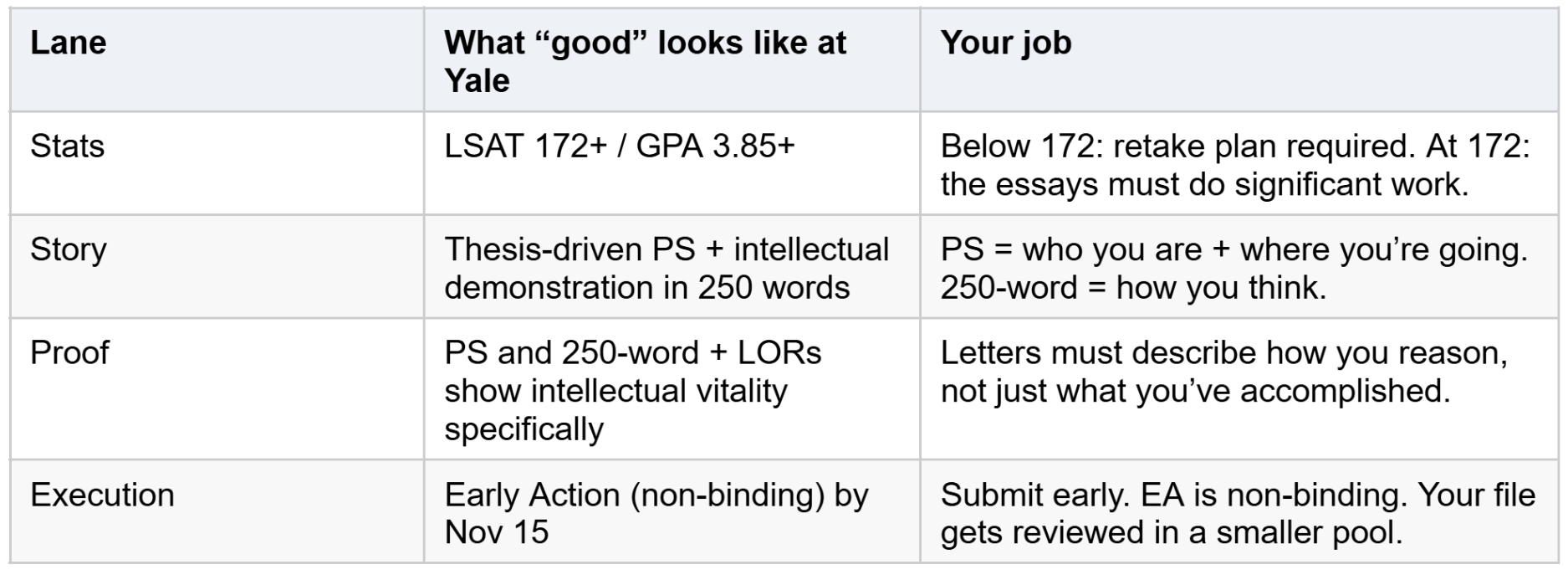
The Yale Admits Formula: Stats × Story × The 250-Word Essay × Execution
Yale’s formula differs from other T6 schools in one critical way: the 250-word supplemental essay is not supplemental. It is a co-equal component with the personal statement, and for applicants in the competitive LSAT range, it is the primary differentiator.
Stats: Floor-setter. Below 172, Yale is not a viable target for most applicants. Above 174, stats do not carry you further.
Story (PS): Argument about who you are, what you have done, and where you are going. Causal logic, not narrative summary.
The 250-Word Essay: Intellectual demonstration. Not what you care about. How you think.
Execution: Early Action by November 15 (non-binding). Letters from people who knew you intellectually.
Step-by-Step Battle Plan
Step 1: Pick Your Score Band
RULE
At Yale, a 176 LSAT applicant with a descriptive 250-word essay will lose to a 172 LSAT applicant with a 250-word essay that demonstrates original intellectual engagement. The essay matters more than the extra LSAT points once you are above the competitive floor.
Step 2: The 250-Word Essay — The One Component Most Applicants Get Wrong
The Yale Law 250-word supplemental essay asks you to describe something you find intellectually challenging or interesting. This sounds open-ended. It is, in fact, a very specific test.
What the committee is evaluating: intellectual character. Not your interests. Not your accomplishments. The specific quality of how your mind engages with a problem.
The failure mode is universal and recognizable: the essay describes what the applicant cares about rather than showing how they think about it. “I became interested in criminal procedure through my public defense work” tells the committee what you do. It does not demonstrate how you think.
A demonstration essay does the opposite: it takes a specific intellectual problem—a doctrinal tension, an empirical puzzle, a theoretical gap—and works through it in 250 words with enough precision, rigor, and original perspective that the committee finishes reading and thinks: this person thinks in an interesting way.
Three structural approaches for the 250-word essay:
RULE — The 250-Word Essay Test
Read your essay draft. Does it say something specific that could be wrong? Could a reasonable, intelligent reader disagree with it? If not, you have written a description, not a demonstration. Rewrite from a specific, arguable claim.
What the 250-word essay is not:
A compressed personal statement
A summary of your background or interests
A list of things you found challenging
A statement of passion or purpose
A description of a case or experience that affected you emotionally
INSIGHT — The Withheld Distinction
The best 250-word essays are indistinguishable from the first two pages of a law review note. They identify a tension, take a position, and defend it with precision. The worst ones are personal statements that happened to be 250 words. The committee reads thousands of both. It can tell the difference in the first two sentences.
Step 3: Story Plan — Origin → Proof → Yale Bridge
The personal statement and the 250-word essay work together. The PS establishes who you are and where you are going. The 250-word essay demonstrates how your mind works. Both should support the same thesis.
Build your 3-layer narrative stack for the PS:
Origin: the credible moment you identified the specific problem you are going to work on.
Proof of commitment: actions you have taken—not interests you have developed, but things you have actually done that show you are already working on this problem.
Yale bridge: the specific argument for why Yale’s platform is necessary. Yale’s bridge looks different from Harvard’s: it centers on intellectual community and access to academic production infrastructure, not just career pipelines.
The Yale bridge has two components that most applicants miss:
First, Yale’s ungraded first term and non-ranked curriculum. For applicants who want to produce intellectual work during law school—writing, clinical research, interdisciplinary scholarship—Yale’s structure supports that in a way that ranked, graded programs do not. If this describes your goals, say so specifically.
Second, Yale’s small class. In a 200-person class, every professor knows every student. If your intended work is academic or requires close faculty mentorship, the small class model is not a generic benefit—it is a specific structural advantage. Name the faculty member whose work engages your problem and argue for access to them specifically.
RULE
Your Yale bridge must connect backward to a specific proof point and forward to a specific action or outcome. “Yale’s intellectual community” is not a bridge—it is a description of every law school’s marketing copy. “Professor [Name]’s work on [specific doctrine] directly engages the gap I have been working to address, and Yale’s small seminar model means I will be in a room with her rather than 100 students” is a bridge.
Step 4: Proof Plan
Resume: build intellectual proof, not just outcome proof.
Yale’s committee reads resumes looking for evidence that you produce analytical work, not just that you execute tasks effectively. Proof-dense bullets at Yale need to demonstrate intellectual contribution in addition to operational outcomes:
"Authored 40-page analysis of [regulatory gap] used as primary reference in three subsequent policy filings."
"Developed original methodological framework for [study type]; framework adopted by two partner organizations."
"Presented original research at [conference]; paper invited for revision and resubmission at [journal]."
Letters of recommendation at Yale: the committee reads letters for evidence of intellectual engagement specifically. Who to ask: a professor who assigned substantive analytical work that you engaged with at a level that stood out, and a professional supervisor who can describe the quality of your analytical thinking in context.
What the letter must convey at Yale: not that you are hardworking, responsible, or committed. That you think in an interesting way. Preload your recommenders with specific intellectual interactions—a seminar debate, a paper argument you constructed, a moment where you challenged a conventional interpretation—so they can write evidence rather than praise.
Step 5: Stats Plan
The realistic LSAT target for a competitive Yale application is 172 or above. A 170 is at the 25th percentile—one in four admitted students scored at or below this level. These are not charity admits. They are applicants whose 250-word essays demonstrated intellectual engagement that was genuinely rare in the pool.
If your LSAT is below 172, the retake calculation:
Run your last five full-length timed PTs. What is the average?
If the average is 172+, you have a retake case. Register for the next available date.
If the average is 170–171 and has been flat for 3+ months, your preparation ceiling may be in this range. Evaluate whether additional preparation or strategy changes can move the score before deciding.
If the average is below 170 consistently, Yale is not your current cycle target.
RULE
Yale considers all LSAT scores and weights the highest. A score improvement between attempts is read positively—it signals that the first attempt was not your ceiling. An unexplained score drop invites scrutiny. Write a brief addendum addressing any significant score variance.
Step 6: Financial Aid — COAP and the Yale Math
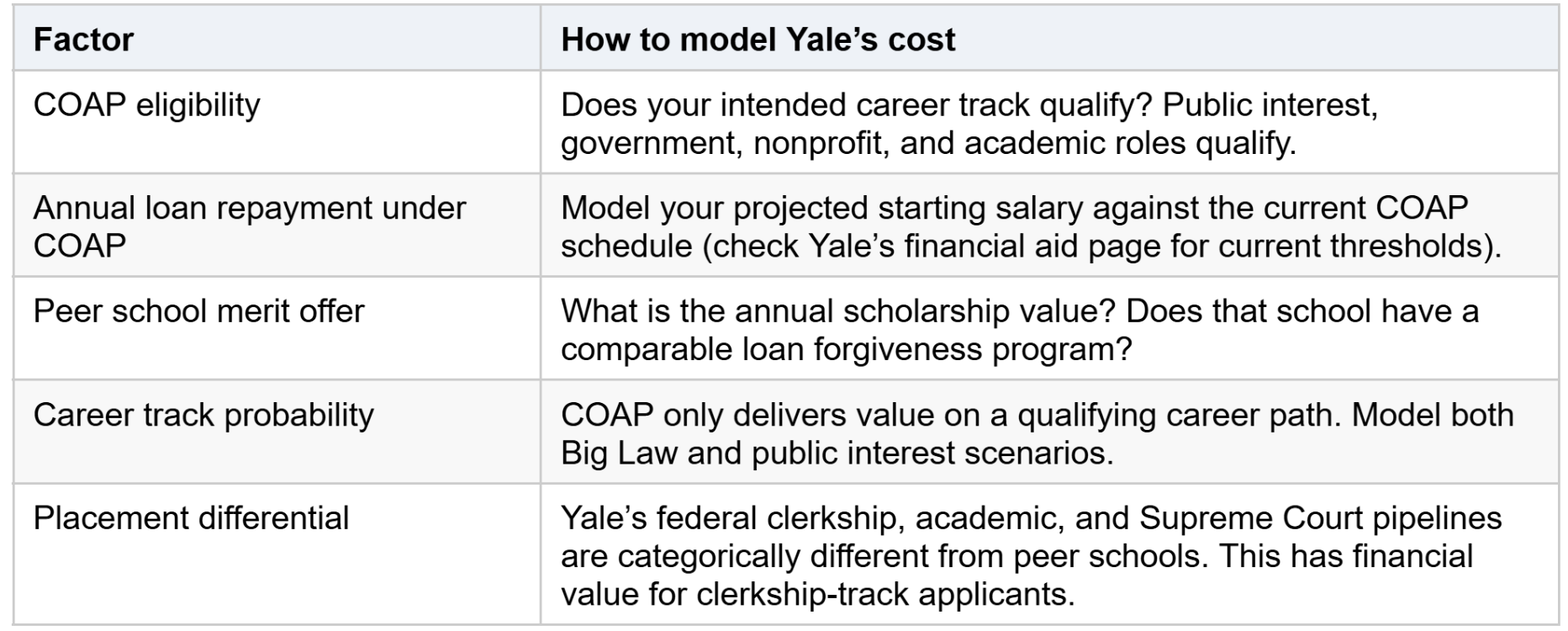
Yale offers no merit scholarships. All aid is need-based. The Career Options Assistance Program (COAP) covers loan repayment for graduates in qualifying public interest, government, and academic careers who earn below the program income threshold.
COAP has no application deadline—it is available indefinitely after graduation. For qualifying Yale graduates, COAP can cover full loan repayment at lower income levels and a sliding percentage at higher income levels within the threshold band.
Step 7: Timing Plan — Early Action vs. Regular Decision
Yale operates an Early Action program with a November 15 deadline. EA is non-binding. You can submit, receive an early decision, and accept or decline based on the full picture of your options.
The strategic argument for Early Action:
Your file is reviewed against a smaller pool in the EA round.
Decisions for EA applicants begin in December, giving you more time to evaluate competing offers.
Early submission signals seriousness and commitment without binding you to anything.
RULE
Submit Early Action if your file is genuinely complete by November 1—giving two weeks for final review before the November 15 deadline. Do not rush an incomplete file to hit EA. A strong file submitted January 15 is better than a weak file submitted November 15.
TEMPLATE — Adapt to your specific intellectual problem
[Name the specific tension or problem. State it precisely: what two things are in tension, or what gap exists between how something works and how it should work.] [In two to three sentences: work through the tension. Take a position. Show that you have thought about this at a level of precision beyond the obvious.] [In the final sentences: name the implication of your position—what changes if you are right, or what problem remains if the tension is not resolved.]Note: Do not write more than 250 words. Do not introduce yourself. Do not describe how you came to care about this topic. Start with the idea, stay with the idea, end with the idea.
Template: Personal Statement Opening (Yale Version)
TEMPLATE — Adapt to your specific thesis
[State the specific problem you are going to work on. Name it precisely—not “criminal justice reform” but the specific doctrine, mechanism, or gap.] [State what you have done that proves you are already working on it—one or two proof points.] [State why Yale specifically. Not “Yale’s intellectual community” but a named faculty member, program, or structural feature that directly serves your stated goal.] That argument is what this personal statement makes.
Template: Yale Bridge Paragraph
TEMPLATE — Adapt to your specific Yale connection
Because [your track record + the specific problem], I need [legal training + academic production infrastructure]. Yale provides that through [named faculty whose work engages your problem], [specific clinic or program], and [structural feature—small class, ungraded first term, academic pipeline]—which positions me to [specific next step within 3 years] and ultimately [longer-term measurable outcome].
Template: LOR Brief for Yale Recommenders
TEMPLATE — Attach to LOR request
What I need from this letter: evidence of how I think, not just what I’ve accomplished. The committee at Yale reads letters specifically for intellectual engagement—moments where I engaged with an idea at a level that stood out.Specific interactions you could describe:• [Moment 1: specific analytical exchange, debate, or paper argument]• [Moment 2: specific intellectual challenge I engaged with]• [Moment 3: moment I took intellectual risk or challenged a conventional interpretation]My one-sentence thesis: [thesis here]Deadline: [date with buffer].
Common Mistakes
Writing a 250-word essay that describes what you find interesting rather than demonstrating how you think about it. The committee reads thousands of “I became fascinated by X when” essays. They are recognizable and forgettable.
Writing the 250-word essay as a compressed personal statement. They are different products. The PS argues for you. The 250-word essay demonstrates your mind.
Choosing a “safe” 250-word essay topic—one that is interesting but does not commit you to a position. Yale rewards intellectual specificity. Hedged, careful essays that avoid commitment signal the opposite of intellectual vitality.
Citing “Yale’s intellectual community” or “the caliber of my peers” as reasons for attending. These are descriptions of every T14 school. They are not arguments.
Writing a personal statement that tells a narrative chronology rather than making an argument. Narrative summaries are the default. Arguments are rare.
Asking recommenders for letters without giving them specific intellectual interactions to anchor the letter.
Submitting by the February deadline when the November Early Action deadline was achievable.
Metrics: Your Yale Applicant KPI Dashboard
Troubleshooting (If / Then)
LSAT at 172 + strong everything else, but essays are generic → The essays are the problem. Rewrite the 250-word from a position. A 172 with exceptional essays is a stronger Yale file than a 175 with a descriptive 250-word.
250-word essay is 250 words but feels thin → You are hedging. Take a specific position in sentence one. The discomfort of committing to an arguable claim is the right signal.
Story sounds generic despite interesting background → Reduce to one throughline and one specific problem. Remove any paragraph that could be transplanted into another applicant’s PS without being false.
LOR writers cannot recall specific intellectual interactions → Send them the specific prompts from the LOR brief template. If no specific interaction exists to describe, evaluate whether this recommender is the right choice.
Yale vs. Harvard decision unclear → Distinguish on mission: Yale is for applicants who want to produce legal scholarship, build academic careers, or work in policy at the highest level where the Yale network is structurally superior. Harvard is for applicants who want the broadest possible career optionality. Choose based on your actual intent.
Waitlisted → Send a focused Letter of Continued Interest with a specific update—new publication, promotion, retake score, or specific new Yale resource you have identified. Generically reaffirming your interest is not a LOCI.
Worked Example
Profile: LSAT 172 (below median) / GPA 3.88 / 2 years at a federal research institution working on AI governance policy + one published working paper.
Stats decision: 172 is at Yale’s 25th percentile. Run the retake analysis. If PT average is 174+, register for the next date. If PTs are flat at 172–173, keep the score and make the essays exceptional.
250-word essay approach: Use the disciplinary lens approach. Bring your AI governance expertise to bear on a specific gap in current administrative law doctrine—the gap between how AI systems make decisions and what due process requires. Take a position in sentence one. Argue for it with precision in the body. Close with the implication.
PS narrative stack: Origin—a specific regulatory proceeding where the legal framework was visibly inadequate. Proof—one published working paper and two years of policy work. Yale bridge—Professor [relevant Yale faculty member]’s scholarship on [specific doctrine] engages the exact gap your working paper identifies; Yale’s small seminar model means this is a working relationship, not a proximity benefit.
INSIGHT
This file is competitive at Yale despite a below-median LSAT because the 250-word essay is doing exactly what Yale asks: demonstrating how the applicant thinks about a specific problem, not describing what they care about. The combination of disciplinary expertise + specific doctrinal argument + named faculty bridge is what moves a 172 LSAT file into consideration.
Next Steps: Your 7-Day Sprint
Day 1: Set your band vs. medians. Run your LSAT retake analysis. Model COAP if comparing Yale to a merit offer.
Day 2: Identify your 250-word essay approach (problem-tension / disciplinary lens / close reading). Write a one-sentence claim for the essay.
Day 3: Draft the 250-word essay using your claim as the first sentence. Do not edit—just draft.
Day 4: Revise the 250-word essay. Test the claim: is it specific enough that someone could disagree with it? If not, sharpen.
Day 5: Draft PS opening paragraph with your thesis. Write the Yale bridge paragraph.
Day 6: Send LOR requests with intellectual story prompts. Confirm deadlines.
Day 7: Audit both essays against the same one-sentence thesis. They should work together, not independently.
Direct Answer
To get into Yale Law, your LSAT must be at or above 172, and your 250-word essay must demonstrate intellectual engagement with a specific idea—not describe your interests. Yale reads for intellectual vitality above all other qualitative factors. The personal statement and 250-word essay work together as a single argument about who you are and how you think. Submit Early Action by November 15 (non-binding) when your file is ready.
Decision Tree: Early Action vs. Regular Decision
File is complete and strong before November 1 → Submit Early Action (non-binding).
250-word essay is not demonstrating intellectual engagement yet → Do not submit until it does. Missing EA for a better essay is the right trade.
LSAT retake scheduled after November 15 → Submit Regular Decision.
Yale vs. Harvard decision → Distinguish on academic production intent vs. career optionality breadth. Both require exceptional essays. Choose based on what you actually plan to do with the degree.
FAQs
Questions answered so you can get started quickly.
What does Arizona State Sandra Day O'Connor College of Law look for in personal statements?
Arizona State Sandra Day O'Connor College of Law reads for Arizona market ties
What does Berkeley Law look for in personal statements?
Berkeley Law reads for public interest
What does Boston College Law School look for in personal statements?
Boston College Law School reads for BC's Jesuit mission
What does Boston University School of Law look for in personal statements?
Boston University School of Law reads for IP
What does Columbia Law School look for in personal statements?
Columbia Law School reads for specific New York market ambitions and Columbia's cross-disciplinary strengths (business law
What does Cornell Law School look for in personal statements?
Cornell Law School reads for Cornell's tight-knit Ivy League community
What does Duke Law School look for in personal statements?
Duke Law School reads for Duke's leadership-focused culture
What does Emory Law School look for in personal statements?
Emory Law School reads for Atlanta market
What does Fordham Law School look for in personal statements?
Fordham Law School reads for New York market connection
What does Georgetown Law look for in personal statements?
Georgetown Law reads for DC policy
What does GWU Law School look for in personal statements?
GWU Law School reads for government
What does Harvard Law School look for in personal statements?
Harvard Law School reads for intellectual leadership and a vision for using law to solve a problem at scale. The most common failure in personal statements is generality — statements that could describe any top law school and any applicant with a law-adjacent interest. The committee at Harvard Law School has read thousands of such statements. The personal statements that generate admissions decisions are specific enough to be falsifiable: they name a problem
What does Northwestern Pritzker School of Law look for in personal statements?
Northwestern Pritzker School of Law reads for Northwestern's strong preference for work experience
What does Notre Dame Law School look for in personal statements?
Notre Dame Law School reads for values alignment
What does NYU School of Law look for in personal statements?
NYU School of Law reads for global law
What does Ohio State Moritz College of Law look for in personal statements?
Ohio State Moritz College of Law reads for Ohio/Midwest market ties
What does Stanford Law School look for in personal statements?
Stanford Law School reads for intellectual distinctiveness
What does UC Davis School of Law look for in personal statements?
UC Davis School of Law reads for California market ties
What does UC Irvine School of Law look for in personal statements?
UC Irvine School of Law reads for California market ambitions
What does UCLA School of Law look for in personal statements?
UCLA School of Law reads for California market connections
What does University of Chicago Law School look for in personal statements?
University of Chicago Law School reads for law and economics methodology
What does University of Michigan Law School look for in personal statements?
University of Michigan Law School reads for Michigan's collaborative culture
What does University of Minnesota Law School look for in personal statements?
University of Minnesota Law School reads for Minnesota market ties
What does University of Pennsylvania Carey Law School look for in personal statements?
University of Pennsylvania Carey Law School reads for Penn's Wharton and business school connections
What does University of Texas School of Law look for in personal statements?
University of Texas School of Law reads for Texas market ties
What does University of Virginia School of Law look for in personal statements?
University of Virginia School of Law reads for UVA's community-focused culture
What does USC Gould School of Law look for in personal statements?
USC Gould School of Law reads for LA market ties
What does Vanderbilt Law School look for in personal statements?
Vanderbilt Law School reads for Vanderbilt's Nashville market access
What does Wake Forest University School of Law look for in personal statements?
Wake Forest University School of Law reads for Wake Forest's small community
What does Washington University in St. Louis School of Law look for in personal statements?
Washington University in St. Louis School of Law reads for WashU's strong scholarship program
What does Yale Law School look for in personal statements?
Yale Law School reads for original legal thinking
Who can use the Playbooks?
Our Playbooks are designed for students, professionals, and anyone looking to enhance their skills in the specific topic area.
Are the Playbooks updated regularly?
Absolutely — we review and update our Playbooks periodically to ensure the content stays relevant and accurate.
How does Arizona State Sandra Day O'Connor College of Law's waitlist work?
Arizona State Sandra Day O'Connor College of Law's waitlist — moderate movement"; ASU's rolling admissions process and in-state/out-of-state pricing creates some yield variability; waitlist activity is higher for out-of-state applicants. The most effective waitlist strategy has three components: (1) a Letter of Continued Interest (LOCI) submitted promptly after being waitlisted
How does Berkeley Law's waitlist work?
Berkeley Law's waitlist — active in most cycles"; Berkeley's mission-driven applicant pool creates yield variability; a LOCI that demonstrates genuine public interest commitment rather than generic enthusiasm performs best. The most effective waitlist strategy has three components: (1) a Letter of Continued Interest submitted promptly after being waitlisted
How does Boston College Law School's waitlist work?
Boston College Law School's waitlist — active in most cycles"; BC's acceptance rate of 8.5% masks significant waitlist movement; demonstrated first-choice interest is weighed. The most effective waitlist strategy has three components: (1) a Letter of Continued Interest (LOCI) submitted promptly after being waitlisted
How does Boston University School of Law's waitlist work?
Boston University School of Law's waitlist — active waitlist — BU uses it to manage yield from a large aspirational pool"; a strong LOCI with first-choice commitment and updated credentials moves. The most effective waitlist strategy has three components: (1) a Letter of Continued Interest (LOCI) submitted promptly after being waitlisted
How does Columbia Law School's waitlist work?
Columbia Law School's waitlist — moderately active"; Columbia's high yield means limited waitlist movement most years; update with new LSAT or publications. The most effective waitlist strategy has three components: (1) a Letter of Continued Interest (LOCI) submitted promptly after being waitlisted
How does Cornell Law School's waitlist work?
Cornell Law School's waitlist — moderate activity"; Cornell's smaller class creates some waitlist movement; demonstrated first-choice preference and updated credentials are the key variables. The most effective waitlist strategy has three components: (1) a Letter of Continued Interest submitted promptly after being waitlisted
How does Duke Law School's waitlist work?
Duke Law School's waitlist — moderate movement"; Duke's yield from a national applicant pool creates some waitlist variability; a LOCI with updated LSAT and Duke-specific program reasoning performs well. The most effective waitlist strategy has three components: (1) a Letter of Continued Interest submitted promptly after being waitlisted
How does Emory Law School's waitlist work?
Emory Law School's waitlist — moderately active"; Emory's broad applicant pool creates some waitlist movement; an updated LSAT or strong LOCI citing Atlanta-specific career goals helps. The most effective waitlist strategy has three components: (1) a Letter of Continued Interest (LOCI) submitted promptly after being waitlisted
How does Fordham Law School's waitlist work?
Fordham Law School's waitlist — active — Fordham's acceptance rate of 16.2% is tighter than it appears"; the waitlist moves regularly; demonstrated first-choice commitment strengthens LOCI. The most effective waitlist strategy has three components: (1) a Letter of Continued Interest (LOCI) submitted promptly after being waitlisted
How does Georgetown Law's waitlist work?
Georgetown Law's waitlist — one of the most active waitlists in T14 — Georgetown enrolls a very large class and pulls from the waitlist regularly. The most effective waitlist strategy has three components: (1) a Letter of Continued Interest (LOCI) submitted promptly after being waitlisted
How does GWU Law School's waitlist work?
GWU Law School's waitlist — active waitlist — GWU's large class and rolling admissions process means meaningful waitlist movement most cycles. The most effective waitlist strategy has three components: (1) a Letter of Continued Interest (LOCI) submitted promptly after being waitlisted
How does Harvard Law School's waitlist work?
Harvard Law School's waitlist — rarely moves significantly"; most admitted candidates enroll. The most effective waitlist strategy has three components: (1) a Letter of Continued Interest (LOCI) submitted promptly after being waitlisted
How does Northwestern Pritzker School of Law's waitlist work?
Northwestern Pritzker School of Law's waitlist — active in most cycles"; Northwestern's professional-experience preference creates yield variability; a LOCI that emphasizes career development since application submission is particularly effective here. The most effective waitlist strategy has three components: (1) a Letter of Continued Interest submitted promptly after being waitlisted
How does Notre Dame Law School's waitlist work?
Notre Dame Law School's waitlist — moderate activity"; Notre Dame's community focus means demonstrated interest and a strong statement of why Notre Dame specifically can move waitlisted applicants. The most effective waitlist strategy has three components: (1) a Letter of Continued Interest (LOCI) submitted promptly after being waitlisted
How does NYU School of Law's waitlist work?
NYU School of Law's waitlist — moderately active"; NYU's high yield means most years see modest waitlist movement; public interest applicants sometimes have an edge. The most effective waitlist strategy has three components: (1) a Letter of Continued Interest (LOCI) submitted promptly after being waitlisted
How does Ohio State Moritz College of Law's waitlist work?
Ohio State Moritz College of Law's waitlist — moderate movement"; in-state applicants on the waitlist have a meaningful advantage; an LOCI demonstrating Ohio career intent and first-choice preference is the key variable. The most effective waitlist strategy has three components: (1) a Letter of Continued Interest (LOCI) submitted promptly after being waitlisted
How does Stanford Law School's waitlist work?
Stanford Law School's waitlist — rarely moves significantly"; Stanford's yield is exceptionally high; waitlisted applicants should submit a LOCI but temper expectations — most Stanford waitlist years see minimal movement. The most effective waitlist strategy has three components: (1) a Letter of Continued Interest submitted promptly after being waitlisted
How does UC Davis School of Law's waitlist work?
UC Davis School of Law's waitlist — moderate activity"; UC Davis's California applicant volume creates some waitlist movement; demonstrated California career intent and first-choice preference are the key LOCI variables. The most effective waitlist strategy has three components: (1) a Letter of Continued Interest submitted promptly after being waitlisted
How does UC Irvine School of Law's waitlist work?
UC Irvine School of Law's waitlist — moderate to active — UCI's small class and California applicant volume create waitlist movement most cycles"; demonstrated California career commitment strengthens the LOCI. The most effective waitlist strategy has three components: (1) a Letter of Continued Interest (LOCI) submitted promptly after being waitlisted
How does UCLA School of Law's waitlist work?
UCLA School of Law's waitlist — active in most cycles"; UCLA's large California applicant pool and in-state preference creates meaningful waitlist movement; demonstrating California career commitment and first-choice preference strengthens the LOCI. The most effective waitlist strategy has three components: (1) a Letter of Continued Interest submitted promptly after being waitlisted
How does University of Chicago Law School's waitlist work?
University of Chicago Law School's waitlist — moderate movement"; UChicago's high yield from a self-selected intellectually serious applicant pool limits waitlist activity; a LOCI that demonstrates genuine engagement with law and economics scholarship is the best differentiator. The most effective waitlist strategy has three components: (1) a Letter of Continued Interest submitted promptly after being waitlisted
How does University of Michigan Law School's waitlist work?
University of Michigan Law School's waitlist — active in most cycles"; Michigan's large national applicant pool creates real waitlist movement; demonstrated first-choice commitment with Michigan-specific program reasoning performs well in LOCI letters. The most effective waitlist strategy has three components: (1) a Letter of Continued Interest submitted promptly after being waitlisted
How does University of Minnesota Law School's waitlist work?
University of Minnesota Law School's waitlist — moderate movement"; Minnesota's in-state preference creates some yield variability; demonstrated Minnesota career intent and first-choice preference are the most effective LOCI variables. The most effective waitlist strategy has three components: (1) a Letter of Continued Interest submitted promptly after being waitlisted
How does University of Pennsylvania Carey Law School's waitlist work?
University of Pennsylvania Carey Law School's waitlist — moderate to low activity"; Penn's yield from a highly self-selected applicant pool limits waitlist movement; a LOCI demonstrating genuine Penn-Wharton interdisciplinary interest is more effective than generic first-choice statements. The most effective waitlist strategy has three components: (1) a Letter of Continued Interest submitted promptly after being waitlisted
How does University of Texas School of Law's waitlist work?
University of Texas School of Law's waitlist — active in most cycles"; UT's in-state preference creates yield variability for out-of-state applicants; demonstrated Texas career intent is the most important LOCI variable. The most effective waitlist strategy has three components: (1) a Letter of Continued Interest submitted promptly after being waitlisted
How does University of Virginia School of Law's waitlist work?
University of Virginia School of Law's waitlist — moderate activity"; UVA's community-focused culture means demonstrated genuine interest and fit carry more weight in LOCI letters than updated credentials alone. The most effective waitlist strategy has three components: (1) a Letter of Continued Interest submitted promptly after being waitlisted
How does USC Gould School of Law's waitlist work?
USC Gould School of Law's waitlist — moderately active"; USC's yield relative to UCLA creates some waitlist variability; applicants waitlisted at USC while admitted at UCLA can use the UCLA offer in a LOCI to prompt scholarship consideration. The most effective waitlist strategy has three components: (1) a Letter of Continued Interest submitted promptly after being waitlisted
How does Vanderbilt Law School's waitlist work?
Vanderbilt Law School's waitlist — active in most cycles"; Vanderbilt's scholarship-driven yield creates meaningful waitlist movement; a competing offer from a peer school mentioned in a LOCI can prompt both admission and scholarship consideration. The most effective waitlist strategy has three components: (1) a Letter of Continued Interest submitted promptly after being waitlisted
How does Wake Forest University School of Law's waitlist work?
Wake Forest University School of Law's waitlist — active in most cycles"; Wake Forest's smaller class creates more waitlist variability; a personal
How does Washington University in St. Louis School of Law's waitlist work?
Washington University in St. Louis School of Law's waitlist — active in most cycles"; WashU's scholarship-driven yield creates real waitlist movement; a LOCI that demonstrates genuine first-choice preference with WashU-specific program reasoning
How does Yale Law School's waitlist work?
Yale Law School's waitlist — highly selective"; some movement in strong yield years; a compelling LOCI with new credentials is the best lever. The most effective waitlist strategy has three components: (1) a Letter of Continued Interest (LOCI) submitted promptly after being waitlisted
How many tutoring sessions will I need to improve my LSAT score?
The number of sessions varies depending on your starting score, target score, and how much time you have before your test date. During an initial consultation, your tutor will assess your current level and recommend a study plan. Most students see meaningful improvement within 8–12 sessions of consistent, focused practice.
Does Arizona State Sandra Day O'Connor College of Law offer merit scholarships?
Arizona State Sandra Day O'Connor College of Law offers competitive merit scholarships for both in-state and out-of-state applicants; LSAT 164+ is typically the threshold for merit consideration. The most important scholarship strategy variable is application timing — schools that run rolling admissions reward Early Action or Early Decision submissions with stronger packages because scholarship pools are fuller in the fall. Scholarship negotiation is also a real lever: if a peer school (similar ranking
Does Berkeley Law offer merit scholarships?
Berkeley Law offers merit scholarships"; Berkeley's in-state tuition makes scholarship dollars go further;" LSAT 171+ with demonstrated public interest credentials creates strong leverage. The most important scholarship strategy variable is application timing — schools that run rolling admissions reward Early Action or Early Decision submissions with stronger packages because scholarship pools are fuller in the fall. Scholarship negotiation is also a real lever: if a peer school offers you a meaningfully better package
Does Boston College Law School offer merit scholarships?
Boston College Law School offers merit scholarships"; BC's relatively lower tuition compared to peers means scholarships stretch further;" LSAT 170+ increases merit consideration. The most important scholarship strategy variable is application timing — schools that run rolling admissions reward Early Action or Early Decision submissions with stronger packages because scholarship pools are fuller in the fall. Scholarship negotiation is also a real lever: if a peer school (similar ranking
Does Boston University School of Law offer merit scholarships?
Boston University School of Law offers merit scholarships"; LSAT 171+ puts you in scholarship consideration territory;" Early Action submission maximizes leverage. The most important scholarship strategy variable is application timing — schools that run rolling admissions reward Early Action or Early Decision submissions with stronger packages because scholarship pools are fuller in the fall. Scholarship negotiation is also a real lever: if a peer school (similar ranking
Does Columbia Law School offer merit scholarships?
Columbia Law School offers limited merit scholarships"; most financial aid is need-based;" admitted applicants with LSAT 174+ can negotiate merit aid. The most important scholarship strategy variable is application timing — schools that run rolling admissions reward Early Action or Early Decision submissions with stronger packages because scholarship pools are fuller in the fall. Scholarship negotiation is also a real lever: if a peer school (similar ranking
Does Cornell Law School offer merit scholarships?
Cornell Law School offers merit scholarships"; LSAT 172+ creates meaningful scholarship leverage;" Cornell competes aggressively for high-LSAT applicants against peer Ivies. The most important scholarship strategy variable is application timing — schools that run rolling admissions reward Early Action or Early Decision submissions with stronger packages because scholarship pools are fuller in the fall. Scholarship negotiation is also a real lever: if a peer school offers you a meaningfully better package
Does Duke Law School offer merit scholarships?
Duke Law School offers merit scholarships"; LSAT 171+ is the threshold for significant consideration;" Duke actively competes for high-LSAT applicants with Georgetown and Notre Dame. The most important scholarship strategy variable is application timing — schools that run rolling admissions reward Early Action or Early Decision submissions with stronger packages because scholarship pools are fuller in the fall. Scholarship negotiation is also a real lever: if a peer school offers you a meaningfully better package
Does Emory Law School offer merit scholarships?
Emory Law School offers merit scholarships"; LSAT 168+ with a strong GPA creates meaningful leverage;" Emory competes aggressively for high-LSAT applicants with scholarship offers. The most important scholarship strategy variable is application timing — schools that run rolling admissions reward Early Action or Early Decision submissions with stronger packages because scholarship pools are fuller in the fall. Scholarship negotiation is also a real lever: if a peer school (similar ranking
Does Fordham Law School offer merit scholarships?
Fordham Law School offers merit scholarships"; Fordham's New York placement competes with higher-ranked schools;" LSAT 168+ typically qualifies for meaningful merit consideration. The most important scholarship strategy variable is application timing — schools that run rolling admissions reward Early Action or Early Decision submissions with stronger packages because scholarship pools are fuller in the fall. Scholarship negotiation is also a real lever: if a peer school (similar ranking
Does Georgetown Law offer merit scholarships?
Georgetown Law offers merit scholarships"; the Dean's Scholarship is competitive;" applicants with LSAT 172+ have meaningful leverage. The most important scholarship strategy variable is application timing — schools that run rolling admissions reward Early Action or Early Decision submissions with stronger packages because scholarship pools are fuller in the fall. Scholarship negotiation is also a real lever: if a peer school (similar ranking
Does GWU Law School offer merit scholarships?
GWU Law School offers merit scholarships"; LSAT 169+ is typically required for significant consideration;" Early Decision applicants often receive stronger packages. The most important scholarship strategy variable is application timing — schools that run rolling admissions reward Early Action or Early Decision submissions with stronger packages because scholarship pools are fuller in the fall. Scholarship negotiation is also a real lever: if a peer school (similar ranking
Does Harvard Law School offer merit scholarships?
Harvard Law School does not offer merit scholarships — all aid is need-based through its generous LRAP program. The most important scholarship strategy variable is application timing — schools that run rolling admissions reward Early Action or Early Decision submissions with stronger packages because scholarship pools are fuller in the fall. Scholarship negotiation is also a real lever: if a peer school (similar ranking
Does Northwestern Pritzker School of Law offer merit scholarships?
Northwestern Pritzker School of Law offers merit scholarships"; LSAT 172+ with strong professional experience creates meaningful leverage;" Northwestern's work-experience preference sometimes benefits applicants with below-median LSATs who have exceptional careers. The most important scholarship strategy variable is application timing — schools that run rolling admissions reward Early Action or Early Decision submissions with stronger packages because scholarship pools are fuller in the fall. Scholarship negotiation is also a real lever: if a peer school offers you a meaningfully better package
Does Notre Dame Law School offer merit scholarships?
Notre Dame Law School offers competitive merit scholarships; strong LSAT scores above 170 typically qualify for significant merit aid. The most important scholarship strategy variable is application timing — schools that run rolling admissions reward Early Action or Early Decision submissions with stronger packages because scholarship pools are fuller in the fall. Scholarship negotiation is also a real lever: if a peer school (similar ranking
Does NYU School of Law offer merit scholarships?
NYU School of Law offers the Furman Academic Scholarship (full tuition) and Root-Tilden-Kern (public interest full tuition); both are competitive but life-changing. The most important scholarship strategy variable is application timing — schools that run rolling admissions reward Early Action or Early Decision submissions with stronger packages because scholarship pools are fuller in the fall. Scholarship negotiation is also a real lever: if a peer school (similar ranking
Does Ohio State Moritz College of Law offer merit scholarships?
Ohio State Moritz College of Law strong merit scholarship program
Does Stanford Law School offer merit scholarships?
Stanford Law School does not offer merit scholarships — all aid is need-based"; Stanford's LRAP is generous for public interest graduates;" financial strategy should account for need-based aid rather than merit negotiation. The most important scholarship strategy variable is application timing — schools that run rolling admissions reward Early Action or Early Decision submissions with stronger packages because scholarship pools are fuller in the fall. Scholarship negotiation is also a real lever: if a peer school offers you a meaningfully better package
Does UC Davis School of Law offer merit scholarships?
UC Davis School of Law offers merit scholarships"; UC Davis's in-state tuition makes scholarship dollars highly effective;" LSAT 166+ creates meaningful leverage for both in-state and out-of-state applicants. The most important scholarship strategy variable is application timing — schools that run rolling admissions reward Early Action or Early Decision submissions with stronger packages because scholarship pools are fuller in the fall. Scholarship negotiation is also a real lever: if a peer school offers you a meaningfully better package
Does UC Irvine School of Law offer merit scholarships?
UC Irvine School of Law offers merit scholarships
Does UCLA School of Law offer merit scholarships?
UCLA School of Law offers merit scholarships"; LSAT 171+ with a strong GPA creates meaningful leverage;" UCLA's in-state tuition advantage means scholarships stretch significantly further than at private peers. The most important scholarship strategy variable is application timing — schools that run rolling admissions reward Early Action or Early Decision submissions with stronger packages because scholarship pools are fuller in the fall. Scholarship negotiation is also a real lever: if a peer school offers you a meaningfully better package
Does University of Chicago Law School offer merit scholarships?
University of Chicago Law School offers merit scholarships"; LSAT 174+ creates meaningful leverage;" UChicago competes for top applicants against Columbia and NYU with scholarship offers. The most important scholarship strategy variable is application timing — schools that run rolling admissions reward Early Action or Early Decision submissions with stronger packages because scholarship pools are fuller in the fall. Scholarship negotiation is also a real lever: if a peer school offers you a meaningfully better package
Does University of Michigan Law School offer merit scholarships?
University of Michigan Law School offers merit scholarships"; LSAT 172+ creates meaningful consideration;" Michigan uses scholarship offers to compete with peer schools for strong out-of-state applicants. The most important scholarship strategy variable is application timing — schools that run rolling admissions reward Early Action or Early Decision submissions with stronger packages because scholarship pools are fuller in the fall. Scholarship negotiation is also a real lever: if a peer school offers you a meaningfully better package
Does University of Minnesota Law School offer merit scholarships?
University of Minnesota Law School strong merit scholarship program"; Minnesota's in-state tuition makes it one of the highest-value T1 options in the Midwest;" LSAT 165+ creates meaningful scholarship consideration. The most important scholarship strategy variable is application timing — schools that run rolling admissions reward Early Action or Early Decision submissions with stronger packages because scholarship pools are fuller in the fall. Scholarship negotiation is also a real lever: if a peer school offers you a meaningfully better package
Does University of Pennsylvania Carey Law School offer merit scholarships?
University of Pennsylvania Carey Law School offers merit scholarships"; Penn's 9% acceptance rate means scholarship competition is intense;" LSAT 173+ creates meaningful leverage
Does University of Texas School of Law offer merit scholarships?
University of Texas School of Law highly competitive merit scholarships for both in-state and out-of-state applicants"; UT's in-state tuition makes it one of the highest-value T14 options;" LSAT 171+ creates strong scholarship leverage. The most important scholarship strategy variable is application timing — schools that run rolling admissions reward Early Action or Early Decision submissions with stronger packages because scholarship pools are fuller in the fall. Scholarship negotiation is also a real lever: if a peer school offers you a meaningfully better package
Does University of Virginia School of Law offer merit scholarships?
University of Virginia School of Law offers merit scholarships"; LSAT 172+ with strong GPA creates meaningful leverage;" UVA competes with Georgetown and Michigan for strong applicants using scholarship offers. The most important scholarship strategy variable is application timing — schools that run rolling admissions reward Early Action or Early Decision submissions with stronger packages because scholarship pools are fuller in the fall. Scholarship negotiation is also a real lever: if a peer school offers you a meaningfully better package
Does USC Gould School of Law offer merit scholarships?
USC Gould School of Law offers competitive merit scholarships"; USC uses scholarship offers aggressively to compete for high-LSAT applicants against UCLA;" LSAT 169+ creates real negotiating leverage with both schools simultaneously. The most important scholarship strategy variable is application timing — schools that run rolling admissions reward Early Action or Early Decision submissions with stronger packages because scholarship pools are fuller in the fall. Scholarship negotiation is also a real lever: if a peer school offers you a meaningfully better package
Does Vanderbilt Law School offer merit scholarships?
Vanderbilt Law School offers competitive merit scholarships"; Vanderbilt uses scholarship packages aggressively to compete for high-LSAT applicants;" LSAT 171+ creates real leverage
Does Wake Forest University School of Law offer merit scholarships?
Wake Forest University School of Law competitive merit scholarships available"; LSAT 164+ creates significant leverage;" Wake Forest actively uses scholarship offers to compete for high-LSAT applicants. The most important scholarship strategy variable is application timing — schools that run rolling admissions reward Early Action or Early Decision submissions with stronger packages because scholarship pools are fuller in the fall. Scholarship negotiation is also a real lever: if a peer school (similar ranking
Does Washington University in St. Louis School of Law offer merit scholarships?
Washington University in St. Louis School of Law one of the most aggressive scholarship programs in the T14"; LSAT 170+ frequently results in significant merit awards;" WashU is a legitimate value play against higher-ranked schools with no scholarship offers — model the net cost comparison carefully. The most important scholarship strategy variable is application timing — schools that run rolling admissions reward Early Action or Early Decision submissions with stronger packages because scholarship pools are fuller in the fall. Scholarship negotiation is also a real lever: if a peer school offers you a meaningfully better package
Does Yale Law School offer merit scholarships?
Yale Law School does not offer merit scholarships — 100% need-based aid; average grant covers most tuition for students with demonstrated need. The most important scholarship strategy variable is application timing — schools that run rolling admissions reward Early Action or Early Decision submissions with stronger packages because scholarship pools are fuller in the fall. Scholarship negotiation is also a real lever: if a peer school (similar ranking
.png)