UC Irvine Law has a 14.9% acceptance rate and 28% BigLaw placement — more selective and better-placing than its ranking suggests. Here is the full admissions playbook.
Introduction UC Irvine Law is a selective Southern California law school with unusually strong BigLaw placement for its ranking, a mission-driven public service culture, and direct access to the Los Angeles and Orange County legal markets. The strongest applications connect a clear career thesis to UCI’s clinics, founding mission, and regional pipeline.
TUITION
$52,000 in-state / $56,000 out-of-state
ACCEPTANCE RATE
14.9%
CLASS SIZE
189
MEDIAN LSAT
168
MEDIAN GPA
3.77
How to Get Into UC Irvine Law School: The Complete Playbook
UC Irvine School of Law has a 14.9% acceptance rate, a median LSAT of 168, and a class of approximately 189 students. Among public law schools, it is the most selectively misunderstood program in the country.
Most applicants who consider UC Irvine treat it as the UC system’s fourth option — below Berkeley, UCLA, and Davis in name recognition, therefore below them in value. That ranking is wrong, and it is costing applicants real money and real career opportunities.
Two applicant profiles:
Profile A (following conventional wisdom): 3.82 GPA + 167 LSAT, applies to Berkeley and UCLA as reaches, Davis as a match, and ignores UC Irvine entirely because it “doesn’t have the history.” Gets waitlisted at Berkeley, rejected at UCLA, and admitted to Davis with a modest scholarship. Attends Davis. Never knew that UC Irvine’s acceptance rate is lower than Davis, its LSAT median is higher, its BigLaw placement is stronger, and its full-scholarship program for the entering class was one of the most aggressive in public legal education.
Profile B (applying with information): 3.80 GPA + 168 LSAT, researches the actual data, discovers that UC Irvine’s 14.9% acceptance rate makes it the most selective UC law school outside Berkeley and UCLA, that its founding full-tuition scholarship program created a culture of merit competition that persists, and that its Southern California OCI pipeline into BigLaw is direct and well-established. Applies, gets admitted with meaningful scholarship consideration, and enters the Los Angeles legal market with a degree that carries more weight than its age suggests.
The data is there. Most applicants do not look at it.
FEATURED SNIPPET
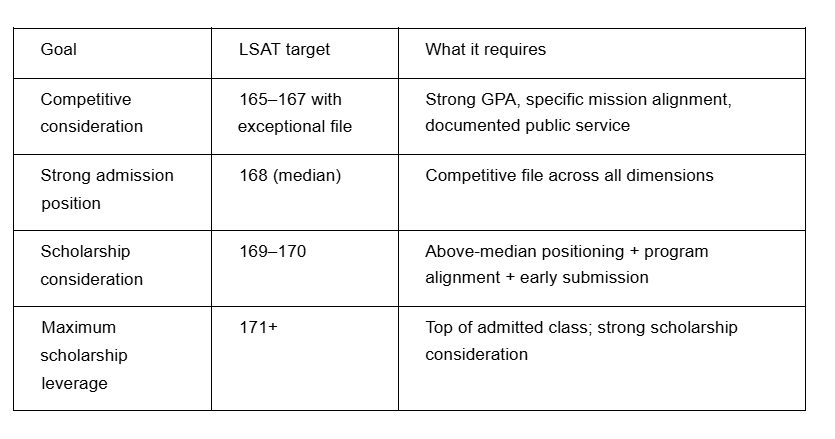
To get into UC Irvine Law School, target a 168 LSAT — the median — and submit early in the rolling cycle. UCI Law’s 14.9% acceptance rate makes it more selective than its ranking suggests, and its Southern California BigLaw pipeline and public interest culture create specific career advantages for applicants who engage them intentionally. Program alignment to UCI’s founding mission and specific clinical offerings is the differentiator between admission and scholarship consideration.
Your UCI Law Scorecard
Setup: UC Irvine Law in Numbers
What the Numbers Actually Mean
A 14.9% acceptance rate on 3,720 applications for 189 seats is the most important number on this page. UCI Law is not a UC safety. It is a selective law school that rejects six of every seven applicants — a more selective rate than many schools ranked 15–20 positions above it.
The LSAT spread matters enormously here. A 164–170 interquartile range at a 168 median means the 25th percentile is already at a score that would be competitive for admission at schools ranked in the T25. UCI’s entire admitted class is operating in a LSAT band that overlaps significantly with T14 and T20 schools. That is a function of the school’s founding strategy — UCI opened in 2009 with aggressive merit scholarships specifically designed to attract top applicants who might otherwise go to higher-ranked schools.
28% BigLaw placement from a school ranked #38 is anomalous. UCI’s BigLaw placement rate exceeds schools ranked 10–15 positions above it. The reason is structural: UCI is in Orange County, 40 miles from Los Angeles. The LA BigLaw market — one of the three largest in the country — recruits directly from UCI OCI. Partners at LA offices of Latham, Gibson Dunn, O’Melveny, and Munger Tolles went to UCI Law. That alumni network, built since 2009 with aggressive scholarship recruiting, is now deep enough to drive placement outcomes that outperform UCI’s ranking.
The out-of-state tuition gap is narrow. In-state and out-of-state tuition at UCI differ by approximately $4,000/year. For out-of-state applicants, this makes UCI financially competitive with private schools in a way that most public universities are not. The effective cost difference between in-state and out-of-state at UCI is minimal compared to schools where the gap is $20,000+/year.
What UCI Law Is Actually Selecting For
UCI Law was founded in 2009 with a specific mission: to be a public law school that produces lawyers committed to public service, social justice, and the kind of legal work that matters for communities. That founding mission is not marketing language — it shapes what the committee selects for in ways that distinguish UCI from other UC schools.
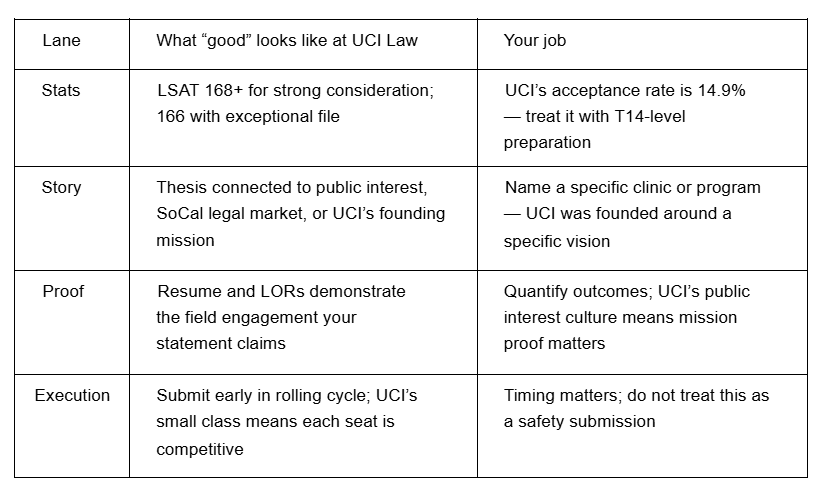
Academic preparation is primary. A 14.9% acceptance rate means the committee is selecting from a highly qualified pool. LSAT and GPA carry significant weight. The interquartile range makes clear that the committee is not accepting applicants below 164 LSAT without exceptional compensating factors.
Public service orientation is the UCI-specific signal. UCI’s founding class received full-tuition scholarships with the explicit expectation that they would pursue careers that served the public interest broadly — including BigLaw, government, public interest, and academic work. The school’s clinical program is one of the most extensive of any law school its size. Applications that demonstrate engagement with public service work, community organizations, policy work, or social justice advocacy are telling the committee something that resonates with the school’s institutional identity.
Program and clinic alignment. UCI’s clinical program is genuinely exceptional for its size. The Immigrant Rights Clinic, the Community and Economic Development Clinic, the Criminal Justice Clinic, and the International Justice Clinic are not supplementary offerings — they are central to the UCI educational model. Applications that name a specific clinic and connect it to documented prior work are making a UCI-specific argument that differentiates from generic law school applications.
RULE
UCI Law’s founding mission means the committee is not just selecting the most credentialed applicants — it is selecting applicants who fit the school’s specific vision of what lawyers should do and who they should serve. An application that demonstrates genuine public service orientation, names a specific UCI clinic, and connects both to prior documented work is a stronger UCI application than one with identical stats but no mission alignment. Know this before you write your personal statement.
The SoCal BigLaw angle. UCI’s 28% BigLaw placement rate is built on its relationship with the LA legal market. Applications from applicants explicitly targeting SoCal BigLaw or entertainment, tech, or entertainment law in Los Angeles are making a program specific career argument. UCI’s OCI presence in LA is disproportionate to its age and ranking. The committee responds to applicants who understand and plan to leverage that pipeline.
The LSAT Score You Actually Need
UCI Law operates at a LSAT level that overlaps with T14 schools. This surprises applicants who have not looked at the data.
The T14 overlap problem. Applicants with 168–171 LSAT scores are also competitive for T14 schools. UCI’s scholarship strategy was designed to capture those applicants with aggressive merit aid. The committee knows it is competing with Georgetown, Notre Dame, and Boston University for applicants in this range. That competition is why UCI’s scholarship offers for above-median applicants are often significant.
The retake calculation at UCI. The gap between a 166 and a 169 at UCI is not just an admissions probability gap — it is the gap between being below median and above median at a school where the scholarship floor sits at the median. For applicants in the 165–167 range, a retake that moves them to 168–169 changes both their admission probability and their scholarship outcome.
RULE
UCI’s acceptance rate of 14.9% means applicants below 165 LSAT face a significantly more difficult admissions path than the school’s ranking suggests. Treat UCI’s LSAT floor with the same seriousness you would apply to a school ranked 15 positions higher. A 162 LSAT is not a UCI application without exceptional compensating factors.
GPA Damage Control
UCI’s 3.77 median and 3.55–3.93 interquartile range gives the committee flexibility to admit applicants across a meaningful GPA range.
3.55–3.75 GPA range: You are in the lower half of the class on GPA but not outside the admitted range. A strong LSAT (169+) with a competitive file is a viable UCI application in this range. An addendum explaining any specific GPA anomalies strengthens the file.
Below 3.55 GPA: The LSAT must carry the academic argument. A 170+ LSAT with a below-median GPA is a splitter file that UCI will consider but not at full scholarship competitiveness. Mission alignment and proof density become more important as the GPA dips.
Upward trend strategy: UCI’s committee reviews transcripts for academic trajectory. A strong final two years after a weaker start is a meaningful signal. Make the trend explicit in your application — a one-paragraph addendum that names what changed is stronger than leaving the committee to calculate it from raw numbers.
The Application Components That Move the Needle
Personal statement. The UCI personal statement that lands is specific about the school’s founding mission and how your background connects to it. UCI was not founded to be another generic top-40 law school — it was founded around a specific vision of what legal education should produce. Applications that demonstrate understanding of and alignment with that vision are fundamentally different from applications that treat UCI as a UC option after Berkeley and UCLA.
The UCI-specific bridges that work:
Clinical program alignment — Name the specific clinic. Immigrant Rights, Criminal Justice, Community and Economic Development, International Justice. Connect it to something you have documented doing. This is the highest-signal UCI-specific argument available.
SoCal BigLaw and entertainment/tech law — UCI’s LA OCI pipeline is a specific career infrastructure. Applicants targeting LA-based practice in BigLaw, entertainment, or tech should name the market, the firms, and UCI’s direct pipeline into that market.
Public interest and social justice — UCI’s founding mission makes this the most resonant personal statement territory. The argument must be specific and documented — not stated interest in justice, but demonstrated engagement with the specific legal problem you intend to address.
UCI faculty research — UCI has built an unusually research-active faculty for a school its age. Connecting to a specific professor’s work in your statement is a high signal move that most applicants skip.
INSIGHT
The single most underused UCI personal statement angle is the clinical program connection. UCI’s clinics are not afterthoughts — they are central to the school’s educational model and a primary reason faculty chose to build their careers at a school founded in 2009 rather than at an established institution. An applicant who connects three years of documented immigration advocacy work to UCI’s Immigrant Rights Clinic is making a mission-coherent argument that the committee hears rarely and responds to strongly.
Letters of recommendation. UCI requires two letters. For public interest-track applicants, one letter from a supervisor in a public service or advocacy context who can speak to the quality and commitment of your mission-aligned work is significantly stronger than two academic letters praising general intellect.
The optional essay. UCI typically offers an optional essay. Use it. A specific argument for why UCI’s founding mission, clinical model, or SoCal placement infrastructure serves your career thesis — in 250–300 words — is a meaningful differentiator in a pool of 3,720 applications.
Application Timeline Strategy
UCI runs rolling admissions. With a 14.9% acceptance rate and 189 seats, the committee processes applications carefully and scholarship decisions are made alongside admissions decisions throughout the cycle.
The October imperative. UCI’s aggressive scholarship strategy — which built the school’s reputation in its early years — is still operative. The committee uses merit aid to compete with T14 schools and higher-ranked programs for applicants in the 168–172 LSAT range. Early-submitted files from competitive applicants receive more scholarship attention because the committee is actively trying to secure enrollments before those applicants receive and act on competing offers.
What to Do If You’re Waitlisted
UCI’s waitlist is active. With a 14.9% acceptance rate and a specific class profile the committee is building, waitlist movement happens when enrolled applicants decline and gaps emerge.
A strong UCI LOCI does three things: confirms continued first-choice interest explicitly, provides a substantive update (LSAT improvement, new public service credential, new publication or award), and reinforces the specific program alignment argument — naming the clinic or career thesis more specifically than the original application did.
What moves UCI’s waitlist: Updated LSAT scores that improve your position relative to the class median, documented new public service work that strengthens your mission alignment argument, and demonstrated first-choice commitment. A generic expression of continued interest is noise in a selective process. A LOCI that adds something material to your file is a different document.
The UCI ROI Case
UCI’s combination of relatively low public school tuition, 28% BigLaw placement, and deep SoCal market penetration creates an ROI profile that outperforms its ranking consistently.
In-state scenario with merit aid: At $52,000/year tuition with $20,000/year in merit scholarship, net annual tuition is $32,000. Three-year net tuition debt of approximately $96,000. With 28% BigLaw placement and LA BigLaw starting salaries at $215,000, the debt-to-income ratio is one of the most favorable of any school outside the T14 for that career path.
Out-of-state scenario: The $4,000/year gap between in-state and out-of-state makes UCI financially near-equivalent for out-of-state applicants. An out-of-state applicant with $20,000/year merit aid attends at effectively the same net cost as an in-state applicant.
The SoCal BigLaw scenario: A UCI graduate entering a Los Angeles BigLaw firm at $215,000 with $90,000–$110,000 in scholarship-adjusted debt has a monthly payment under $1,300 on a 10-year schedule — a debt-to-income ratio that is financially sustainable and clears rapidly on BigLaw compensation.
Lovare’s Take on UCI Law
UC Irvine is the most data-misunderstood law school in the top-40 tier. A 14.9% acceptance rate, a 168 median LSAT, 28% BigLaw placement, and a direct pipeline into one of the three largest legal markets in the country is a value proposition that its ranking — built partly on the school’s young age — does not fully represent.
The applicants who win at UCI are the ones who treated it with T14-level application seriousness, wrote a personal statement that named a specific clinic and connected it to documented prior work, submitted in October, and understood that the SoCal BigLaw pipeline is a specific institutional asset that competes with schools ranked significantly higher for LA market careers.
The applicants who underperform at UCI are the ones who submitted a safety application in January with a personal statement written for Berkeley and UCLA. UCI’s committee reads 3,720 applications. They know what a safety application looks like.
If your LSAT is in the 166–171 range and you have any connection to public service work, SoCal career goals, or UCI’s specific clinical model, this school deserves a primary application — not a fallback submission.
→ Take the Lovare Diagnostic to find out exactly where your LSAT stands relative to UCI’s admission and scholarship thresholds.
Common Mistakes
Treating UCI as a UC safety behind Berkeley and UCLA. UCI’s 14.9% acceptance rate makes it the third most selective law school in the UC system. It is not a safety for any applicant.
Writing a Berkeley or UCLA personal statement with UCI’s name substituted. UCI’s founding mission is specific and the committee recognizes generic applications immediately.
Not naming a specific clinic. UCI’s clinical program is the most distinctive element of its educational model. Applications that mention “strong clinical opportunities” generically are missing the highest-signal UCI-specific argument.
Submitting after January with a score in the 165–167 range. UCI’s scholarship budget and the competitive pressure of its rolling cycle make early submission more consequential here than at most schools its rank.
Ignoring the SoCal BigLaw angle. 28% BigLaw placement feeding directly into LA is UCI’s most underused application asset. If your career target is LA practice, say it explicitly.
If You Only Do 3 Things
1. Target 168 with T14-level application seriousness. UCI’s acceptance rate is 14.9%. Prepare the application you would prepare for a school ranked 15 positions higher.
2. Name a specific clinic in your personal statement. Connect it to something you have documented doing. That connection is the highest-signal UCI-specific argument available and most applicants skip it.
3. Submit in October. UCI’s scholarship strategy is aggressive and rolling. Early submission is the difference between scholarship consideration and sticker attendance at a school where the merit aid gap can be $20,000–$30,000/year.
Questions answered so you can get started quickly.
Does UC Irvine School of Law offer merit scholarships?
UC Irvine School of Law offers merit scholarships
How does UC Irvine School of Law's waitlist work?
UC Irvine School of Law's waitlist — moderate to active — UCI's small class and California applicant volume create waitlist movement most cycles"; demonstrated California career commitment strengthens the LOCI. The most effective waitlist strategy has three components: (1) a Letter of Continued Interest (LOCI) submitted promptly after being waitlisted
What does UC Irvine School of Law look for in personal statements?
UC Irvine School of Law reads for California market ambitions
What GPA do I need for UC Irvine School of Law?
The median undergraduate GPA at UC Irvine School of Law is 3.77. Your LSAC cumulative GPA includes every college institution you attended — community college
What LSAT score do I need for UC Irvine School of Law?
The median LSAT at UC Irvine School of Law is 168. To be competitive for admission