Ohio State Moritz has a 164 median LSAT and 24.6% acceptance rate — but scholarship strategy and program alignment determine your real outcome. Here is the full admissions playbook.
Introduction To get into Ohio State Moritz Law School, target a 164 LSAT and a competitive GPA, submit early in the rolling admissions cycle, and align your application to Moritz’s specific strengths — dispute resolution, public interest, and Big Ten legal market placement. The scholarship floor at Moritz sits above the median LSAT, making score strategy and early submission equally important for your financial outcome.
TUITION
$38,472 in-state / $59,522 out-of-state
ACCEPTANCE RATE
24.6%
CLASS SIZE
159
MEDIAN LSAT
164
MEDIAN GPA
3.91
How to Get Into Ohio State Moritz Law School
Ohio State Moritz has a 24.6% acceptance rate, a median LSAT of 164, and a class of 159 students. Among top-30 public law schools, it is one of the most strategically underutilized programs in the country.
Most applicants who apply to Moritz treat it as a safety. That is the wrong model.
Two applicant profiles:
Profile A (applying as a safety, no positioning): 3.75 GPA + 163 LSAT, applying to six T14 schools with a generic personal statement, adds Moritz to the list in November. No scholarship strategy, no program alignment, no dispute resolution angle. Gets admitted. Pays close to sticker. Leaves $20,000–$40,000 in scholarship money on the table because the file said nothing Moritz-specific.
Profile B (applying with intent): 3.72 GPA + 166 LSAT, identifies early that Moritz’s #1 dispute resolution ranking maps directly to a specific career thesis, writes a personal statement that names the Program on Dispute Resolution and connects it to documented work, submits in October. Gets admitted with a meaningful merit award and attends at a net cost that makes the ROI math significantly better than a lower-ranked school at full pay.
The difference between these profiles is not stats. It is whether the applicant treated Moritz as a destination or a fallback.
FEATURED SNIPPET
To get into Ohio State Moritz Law School, target a 164 LSAT and a competitive GPA, submit early in the rolling admissions cycle, and align your application to Moritz’s specific strengths — dispute resolution, public interest, and Big Ten legal market placement. The scholarship floor at Moritz sits above the median LSAT, making score strategy and early submission equally important for your financial outcome.
Your Moritz Scorecard
Setup: Ohio State Moritz in Numbers
What the Numbers Actually Mean
A 24.6% acceptance rate sounds accessible. It is not generous — it is selective with a smaller applicant pool than coastal schools. Moritz receives 2,291 applications for 159 seats. The acceptance math is tight, and the scholarship math is tighter.
The LSAT spread is the key variable. At 164 median with a class of 159, the 25th percentile sits around 161 and the 75th around 167. That four-point band between the 25th and 75th percentile is where scholarship decisions happen. A 161 applicant gets in with a strong file. A 167 applicant gets in with scholarship money. Understanding where you land in that band determines your entire financial strategy for attending.
The GPA floor is real. A 3.91 median GPA means Moritz is not a destination for applicants with significant grade concerns without a compelling explanation. The committee runs a holistic process, but GPA below 3.6 requires an addendum and strong upward trend evidence to stay competitive.
2,291 applications for 159 seats means Moritz rejects more applicants than most people expect. The 2,291 figure is also significantly lower than Fordham (8,811) or GWU (9,718), which means each application receives more individual attention. Your materials matter more here than at a school processing ten times the volume.
What Moritz Is Actually Selecting For
Moritz evaluates applications on academic potential, personal experience and goals, and personal qualities — in that order by explicit statement. What that means operationally:
Academic potential is proxied by your LSAT and GPA. Moritz has no minimum score, but the admits data makes clear that files below 160 LSAT face a steep hill without exceptional compensating factors.
Personal experience and goals is where Moritz differs from generic T14 review. Moritz explicitly cares about public service orientation. Applicants who have documented engagement with community, government, or mission-driven work — not just stated interest in it — move through the committee differently than pure credentials applicants.
Personal qualities and characteristics signals that Moritz is actively building a class, not sorting a ranking. Leadership in non-legal contexts, demonstrated resilience, and evidence that you know what you are getting into as a lawyer all register.
RULE
Moritz’s holistic review is not a polite euphemism for ignoring stats. Stats remain primary. But the holistic component is more genuinely operative here than at schools processing 8,000+ applications with less time per file. A well-constructed application with a 162 LSAT can compete against a generic application with a 165. That gap narrows fast above the median.
The dispute resolution signal. Moritz is ranked #1 in dispute resolution nationally. This is not a minor specialty — it is the program’s signature identity. Applicants who connect their background to negotiation, mediation, arbitration, or conflict resolution work are telling the committee something that resonates with the school’s core academic mission. Most applicants do not make this connection explicitly. Those who do get noticed.
The LSAT Score You Actually Need
There are three distinct LSAT targets at Moritz. Conflating them is the most common strategic error.
The retake calculation at Moritz is financially specific. Unlike schools with no merit aid, every point above the Moritz median has a direct scholarship translation. The gap between a 163 and a 167 at Moritz is not just an admissions probability gap — it is a financial aid gap that can represent $15,000–$25,000 per year in scholarship money. The retake investment pays off in scholarship dollars at Moritz in a way that it does not at need-only schools.
Rolling timing interacts with LSAT timing. If a retake pushes your submission from October to January, the scholarship budget question becomes real. A 165 submitted in October is a better financial bet than a 167 submitted in February at a school with rolling scholarship allocation.
RULE
The LSAT floor for admission and the LSAT floor for scholarship consideration are different numbers. A 162 can get you in. A 162 will not get you meaningful scholarship money at Moritz. Know which goal you are executing toward before you set your preparation target.
GPA Damage Control
Moritz reads transcripts carefully. The 3.91 median means the committee sees strong academic records constantly. If yours has a weakness, your approach depends on the type of weakness:
Grade dip in one semester or year: Address it in an addendum. One paragraph. Name what happened, show the recovery, do not over-explain. A dip with strong recovery actually demonstrates resilience if framed correctly.
Consistently modest GPA (3.5–3.65): The LSAT carries more weight in your file. A strong LSAT above the median (166+) can offset a GPA in this range if everything else is competitive. A weak LSAT with a modest GPA is a structural problem that no personal statement fixes.
STEM or demanding major with lower GPA: Moritz reviews course difficulty. A 3.6 in electrical engineering reads differently than a 3.6 in communications. Your transcript tells that story if you name it in your application.
GPA below 3.5: You need a compelling addendum, a strong LSAT (167+), and specific proof that the academic performance does not reflect your actual capacity. Work experience and demonstrated achievement in post-undergraduate life matters here.
The Application Components That Move the Needle
Personal statement. The Moritz personal statement should not describe what you have done. It should argue for what you intend to do and why Moritz’s specific infrastructure is the mechanism for getting there. Generic statements about wanting to help people, interest in justice, and passion for the law are noise in 2,291 applications. The statements that land are specific: named career thesis, named program at Moritz, named connection between past proof and future intent.
The program alignment options at Moritz that work as personal statement bridges:
Dispute Resolution Program — #1 nationally. If your work or career thesis has any negotiation, mediation, or conflict resolution component, this is your bridge. It is specific, credible, and directly connects to the school’s identity.
Moritz Public Interest Law Center — for applicants with documented public service work targeting government, nonprofit, or policy careers.
Ohio legal market and Big Ten placement — for applicants targeting Midwest legal careers. Moritz has deep penetration in Columbus, Cleveland, Cincinnati, Chicago, and Indianapolis. If that is your market, say so explicitly.
Specific faculty research — Moritz faculty publish extensively in dispute resolution, civil procedure, and constitutional law. Connecting to a specific professor’s work is a high-signal move that most applicants do not make.
INSIGHT
The most underused Moritz personal statement angle is the explicit Midwest career thesis. Applicants targeting Ohio, Indiana, Illinois, or Michigan legal markets who explicitly state that Moritz’s alumni network and OCI pipeline in those markets is the reason they are applying — not a fallback from T14 rejection — are making a program-specific argument that resonates with the committee. Most applicants pretend they would attend any school. Moritz’s committee knows the difference.
Letters of recommendation. Moritz requires two letters. The standard guidance applies: professors who know your work, or supervisors who can speak to your professional output. The Moritz-specific consideration: if you are making a public interest argument, one letter from a supervisor in a public-service context who can document your commitment is stronger than two academic letters that praise your intellect generally.
Resume. Lead with outcomes, not responsibilities. Moritz’s committee reads resumes for evidence that you understand what legal work requires: analytical rigor, professional judgment, and accountability for outcomes. Quantify wherever possible. Remove anything that reads as credential-stuffing.
Optional essays. Moritz does not always require optional essays, but if a diversity statement or additional information prompt is available, use it purposefully. A diversity statement that describes a perspective you bring to classroom discussion — not a hardship narrative — is a net positive. Additional information should address anything in your file that needs explanation, nothing more.
Application Timeline Strategy
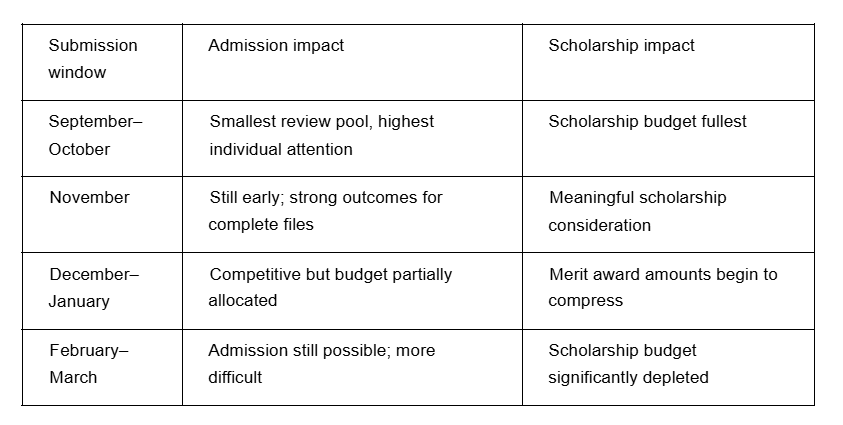
Moritz runs rolling admissions. This is not a formality — it materially affects both admission probability and scholarship outcomes.
The practical implication: if your file is genuinely ready in October, submit in October. The difference between a third-draft personal statement submitted in October and a fifth-draft statement submitted in February is not worth the scholarship budget lost in the interval.
Early Decision option: Moritz offers an Early Binding Decision option for applicants who identify Moritz as their first choice. Successful EBD applicants receive decisions faster and scholarship notification sooner after admission. The binding commitment is real — only use EBD if Moritz is genuinely your first choice and you have modeled the financial outcome.
RULE
Early Decision at Moritz is a legitimate accelerant for applicants who have done the financial modeling and know Moritz is the right call. It is not a strategy for applicants who are uncertain. The binding commitment forecloses the scholarship negotiation leverage you would otherwise have.
What to Do If You’re Waitlisted
Moritz’s waitlist is active. The committee uses it to shape the class profile and fill specific gaps in GPA, LSAT, geography, and career interest distribution.
A strong LOCI for Moritz does three things: confirms continued interest explicitly, provides a substantive update (LSAT improvement, new credential, new work outcome), and makes a specific program alignment argument if you did not make one in your original application.
Timing: Send the LOCI within two weeks of receiving the waitlist notification. Follow up with a brief update if you receive a meaningful new development (LSAT score, job promotion, published work).
What Moritz’s waitlist responds to: Updated LSAT scores, demonstrated first-choice commitment, and specific program fit arguments. A generic LOCI expressing continued interest is noise. A LOCI that adds something material to your file is a different document.
The Moritz ROI Case
Moritz is a public school. In-state tuition at $38,472 is the most favorable cost structure of any top-30 law school in the country. Out-of-state at $59,522 is still competitive relative to private schools at $65,000–$76,000.
The employment math at 93.8% employed at 10 months, with 14% in BigLaw and strong Midwest market penetration, makes the debt-to-income calculation at Moritz more favorable than its US News ranking implies.
The scholarship-stacked scenario: A 166+ LSAT applicant with a strong file admitted with $20,000/year in merit aid is attending a #22 public law school (and the #1 dispute resolution program in the country) for an effective net cost of $18,000–$39,000 per year depending on residency. That ROI calculation beats full-pay attendance at schools ranked 10–15 positions higher for most career paths outside of the T6.
Lovare’s Take on Moritz
Moritz is the most strategically undervalued school in the top-30 tier. Its dispute resolution ranking is not a niche credential — it is a genuine differentiator in commercial litigation, employment law, and government practice. Its public school cost structure makes it the best ROI play in the Midwest for applicants who know what they want to do with a law degree. The applicants who lose at Moritz are the ones who treated it as a backup and wrote backup applications. The ones who win treated it as a destination, named the program, submitted in October, and ran the scholarship math before they applied.
If your LSAT is in the 163–167 range and you have a genuine connection to dispute resolution, public interest, or the Midwest legal market, Moritz deserves a primary application — not a safety submission.
→ Take the Lovare Diagnostic to find out exactly where your LSAT stands and what score moves you into Moritz scholarship range.
Common Mistakes
Treating Moritz as a safety and writing a diluted application. The committee reads 2,291 applications. Generic reads as generic.
Not identifying the LSAT scholarship threshold before applying. A 162 gets you admitted. A 162 does not get you scholarship money. These are different decisions with different LSAT targets.
Submitting in January when the file was ready in October. Rolling scholarship allocation is real. The timing gap has a dollar cost.
Writing a personal statement with no Moritz-specific program reference. If the statement could be submitted to any law school without changing a word, it is not doing its job.
Not addressing GPA weaknesses in an addendum. The committee notices. An addendum that explains contextualizes; silence does not.
Ignoring the Early Decision option without modeling it. EBD at Moritz gives first choice applicants a genuine advantage. If Moritz is genuinely your top choice after running the financial math, EBD is the right execution.
If You Only Do 3 Things
1. Set the right LSAT target. 164 for admission. 166–167 for meaningful scholarship. Know which goal you are executing toward before you start preparing.
2. Submit in October. Rolling scholarship allocation means your financial outcome is partially determined by when you apply, not just what your score is. A ready file in October beats a perfect file in February.
3. Name the dispute resolution program in your personal statement. Connect it to something you have actually done. That sentence alone separates your application from 90% of what the Moritz committee reads.
FAQs
Questions answered so you can get started quickly.
What does Arizona State Sandra Day O'Connor College of Law look for in personal statements?
Arizona State Sandra Day O'Connor College of Law reads for Arizona market ties
What does Berkeley Law look for in personal statements?
Berkeley Law reads for public interest
What does Boston College Law School look for in personal statements?
Boston College Law School reads for BC's Jesuit mission
What does Boston University School of Law look for in personal statements?
Boston University School of Law reads for IP
What does Columbia Law School look for in personal statements?
Columbia Law School reads for specific New York market ambitions and Columbia's cross-disciplinary strengths (business law
What does Cornell Law School look for in personal statements?
Cornell Law School reads for Cornell's tight-knit Ivy League community
What does Duke Law School look for in personal statements?
Duke Law School reads for Duke's leadership-focused culture
What does Emory Law School look for in personal statements?
Emory Law School reads for Atlanta market
What does Fordham Law School look for in personal statements?
Fordham Law School reads for New York market connection
What does Georgetown Law look for in personal statements?
Georgetown Law reads for DC policy
What does GWU Law School look for in personal statements?
GWU Law School reads for government
What does Harvard Law School look for in personal statements?
Harvard Law School reads for intellectual leadership and a vision for using law to solve a problem at scale. The most common failure in personal statements is generality — statements that could describe any top law school and any applicant with a law-adjacent interest. The committee at Harvard Law School has read thousands of such statements. The personal statements that generate admissions decisions are specific enough to be falsifiable: they name a problem
What does Northwestern Pritzker School of Law look for in personal statements?
Northwestern Pritzker School of Law reads for Northwestern's strong preference for work experience
What does Notre Dame Law School look for in personal statements?
Notre Dame Law School reads for values alignment
What does NYU School of Law look for in personal statements?
NYU School of Law reads for global law
What does Ohio State Moritz College of Law look for in personal statements?
Ohio State Moritz College of Law reads for Ohio/Midwest market ties
What does Stanford Law School look for in personal statements?
Stanford Law School reads for intellectual distinctiveness
What does UC Davis School of Law look for in personal statements?
UC Davis School of Law reads for California market ties
What does UC Irvine School of Law look for in personal statements?
UC Irvine School of Law reads for California market ambitions
What does UCLA School of Law look for in personal statements?
UCLA School of Law reads for California market connections
What does University of Chicago Law School look for in personal statements?
University of Chicago Law School reads for law and economics methodology
What does University of Michigan Law School look for in personal statements?
University of Michigan Law School reads for Michigan's collaborative culture
What does University of Minnesota Law School look for in personal statements?
University of Minnesota Law School reads for Minnesota market ties
What does University of Pennsylvania Carey Law School look for in personal statements?
University of Pennsylvania Carey Law School reads for Penn's Wharton and business school connections
What does University of Texas School of Law look for in personal statements?
University of Texas School of Law reads for Texas market ties
What does University of Virginia School of Law look for in personal statements?
University of Virginia School of Law reads for UVA's community-focused culture
What does USC Gould School of Law look for in personal statements?
USC Gould School of Law reads for LA market ties
What does Vanderbilt Law School look for in personal statements?
Vanderbilt Law School reads for Vanderbilt's Nashville market access
What does Wake Forest University School of Law look for in personal statements?
Wake Forest University School of Law reads for Wake Forest's small community
What does Washington University in St. Louis School of Law look for in personal statements?
Washington University in St. Louis School of Law reads for WashU's strong scholarship program
What does Yale Law School look for in personal statements?
Yale Law School reads for original legal thinking
Who can use the Playbooks?
Our Playbooks are designed for students, professionals, and anyone looking to enhance their skills in the specific topic area.
Are the Playbooks updated regularly?
Absolutely — we review and update our Playbooks periodically to ensure the content stays relevant and accurate.
How does Arizona State Sandra Day O'Connor College of Law's waitlist work?
Arizona State Sandra Day O'Connor College of Law's waitlist — moderate movement"; ASU's rolling admissions process and in-state/out-of-state pricing creates some yield variability; waitlist activity is higher for out-of-state applicants. The most effective waitlist strategy has three components: (1) a Letter of Continued Interest (LOCI) submitted promptly after being waitlisted
How does Berkeley Law's waitlist work?
Berkeley Law's waitlist — active in most cycles"; Berkeley's mission-driven applicant pool creates yield variability; a LOCI that demonstrates genuine public interest commitment rather than generic enthusiasm performs best. The most effective waitlist strategy has three components: (1) a Letter of Continued Interest submitted promptly after being waitlisted
How does Boston College Law School's waitlist work?
Boston College Law School's waitlist — active in most cycles"; BC's acceptance rate of 8.5% masks significant waitlist movement; demonstrated first-choice interest is weighed. The most effective waitlist strategy has three components: (1) a Letter of Continued Interest (LOCI) submitted promptly after being waitlisted
How does Boston University School of Law's waitlist work?
Boston University School of Law's waitlist — active waitlist — BU uses it to manage yield from a large aspirational pool"; a strong LOCI with first-choice commitment and updated credentials moves. The most effective waitlist strategy has three components: (1) a Letter of Continued Interest (LOCI) submitted promptly after being waitlisted
How does Columbia Law School's waitlist work?
Columbia Law School's waitlist — moderately active"; Columbia's high yield means limited waitlist movement most years; update with new LSAT or publications. The most effective waitlist strategy has three components: (1) a Letter of Continued Interest (LOCI) submitted promptly after being waitlisted
How does Cornell Law School's waitlist work?
Cornell Law School's waitlist — moderate activity"; Cornell's smaller class creates some waitlist movement; demonstrated first-choice preference and updated credentials are the key variables. The most effective waitlist strategy has three components: (1) a Letter of Continued Interest submitted promptly after being waitlisted
How does Duke Law School's waitlist work?
Duke Law School's waitlist — moderate movement"; Duke's yield from a national applicant pool creates some waitlist variability; a LOCI with updated LSAT and Duke-specific program reasoning performs well. The most effective waitlist strategy has three components: (1) a Letter of Continued Interest submitted promptly after being waitlisted
How does Emory Law School's waitlist work?
Emory Law School's waitlist — moderately active"; Emory's broad applicant pool creates some waitlist movement; an updated LSAT or strong LOCI citing Atlanta-specific career goals helps. The most effective waitlist strategy has three components: (1) a Letter of Continued Interest (LOCI) submitted promptly after being waitlisted
How does Fordham Law School's waitlist work?
Fordham Law School's waitlist — active — Fordham's acceptance rate of 16.2% is tighter than it appears"; the waitlist moves regularly; demonstrated first-choice commitment strengthens LOCI. The most effective waitlist strategy has three components: (1) a Letter of Continued Interest (LOCI) submitted promptly after being waitlisted
How does Georgetown Law's waitlist work?
Georgetown Law's waitlist — one of the most active waitlists in T14 — Georgetown enrolls a very large class and pulls from the waitlist regularly. The most effective waitlist strategy has three components: (1) a Letter of Continued Interest (LOCI) submitted promptly after being waitlisted
How does GWU Law School's waitlist work?
GWU Law School's waitlist — active waitlist — GWU's large class and rolling admissions process means meaningful waitlist movement most cycles. The most effective waitlist strategy has three components: (1) a Letter of Continued Interest (LOCI) submitted promptly after being waitlisted
How does Harvard Law School's waitlist work?
Harvard Law School's waitlist — rarely moves significantly"; most admitted candidates enroll. The most effective waitlist strategy has three components: (1) a Letter of Continued Interest (LOCI) submitted promptly after being waitlisted
How does Northwestern Pritzker School of Law's waitlist work?
Northwestern Pritzker School of Law's waitlist — active in most cycles"; Northwestern's professional-experience preference creates yield variability; a LOCI that emphasizes career development since application submission is particularly effective here. The most effective waitlist strategy has three components: (1) a Letter of Continued Interest submitted promptly after being waitlisted
How does Notre Dame Law School's waitlist work?
Notre Dame Law School's waitlist — moderate activity"; Notre Dame's community focus means demonstrated interest and a strong statement of why Notre Dame specifically can move waitlisted applicants. The most effective waitlist strategy has three components: (1) a Letter of Continued Interest (LOCI) submitted promptly after being waitlisted
How does NYU School of Law's waitlist work?
NYU School of Law's waitlist — moderately active"; NYU's high yield means most years see modest waitlist movement; public interest applicants sometimes have an edge. The most effective waitlist strategy has three components: (1) a Letter of Continued Interest (LOCI) submitted promptly after being waitlisted
How does Ohio State Moritz College of Law's waitlist work?
Ohio State Moritz College of Law's waitlist — moderate movement"; in-state applicants on the waitlist have a meaningful advantage; an LOCI demonstrating Ohio career intent and first-choice preference is the key variable. The most effective waitlist strategy has three components: (1) a Letter of Continued Interest (LOCI) submitted promptly after being waitlisted
How does Stanford Law School's waitlist work?
Stanford Law School's waitlist — rarely moves significantly"; Stanford's yield is exceptionally high; waitlisted applicants should submit a LOCI but temper expectations — most Stanford waitlist years see minimal movement. The most effective waitlist strategy has three components: (1) a Letter of Continued Interest submitted promptly after being waitlisted
How does UC Davis School of Law's waitlist work?
UC Davis School of Law's waitlist — moderate activity"; UC Davis's California applicant volume creates some waitlist movement; demonstrated California career intent and first-choice preference are the key LOCI variables. The most effective waitlist strategy has three components: (1) a Letter of Continued Interest submitted promptly after being waitlisted
How does UC Irvine School of Law's waitlist work?
UC Irvine School of Law's waitlist — moderate to active — UCI's small class and California applicant volume create waitlist movement most cycles"; demonstrated California career commitment strengthens the LOCI. The most effective waitlist strategy has three components: (1) a Letter of Continued Interest (LOCI) submitted promptly after being waitlisted
How does UCLA School of Law's waitlist work?
UCLA School of Law's waitlist — active in most cycles"; UCLA's large California applicant pool and in-state preference creates meaningful waitlist movement; demonstrating California career commitment and first-choice preference strengthens the LOCI. The most effective waitlist strategy has three components: (1) a Letter of Continued Interest submitted promptly after being waitlisted
How does University of Chicago Law School's waitlist work?
University of Chicago Law School's waitlist — moderate movement"; UChicago's high yield from a self-selected intellectually serious applicant pool limits waitlist activity; a LOCI that demonstrates genuine engagement with law and economics scholarship is the best differentiator. The most effective waitlist strategy has three components: (1) a Letter of Continued Interest submitted promptly after being waitlisted
How does University of Michigan Law School's waitlist work?
University of Michigan Law School's waitlist — active in most cycles"; Michigan's large national applicant pool creates real waitlist movement; demonstrated first-choice commitment with Michigan-specific program reasoning performs well in LOCI letters. The most effective waitlist strategy has three components: (1) a Letter of Continued Interest submitted promptly after being waitlisted
How does University of Minnesota Law School's waitlist work?
University of Minnesota Law School's waitlist — moderate movement"; Minnesota's in-state preference creates some yield variability; demonstrated Minnesota career intent and first-choice preference are the most effective LOCI variables. The most effective waitlist strategy has three components: (1) a Letter of Continued Interest submitted promptly after being waitlisted
How does University of Pennsylvania Carey Law School's waitlist work?
University of Pennsylvania Carey Law School's waitlist — moderate to low activity"; Penn's yield from a highly self-selected applicant pool limits waitlist movement; a LOCI demonstrating genuine Penn-Wharton interdisciplinary interest is more effective than generic first-choice statements. The most effective waitlist strategy has three components: (1) a Letter of Continued Interest submitted promptly after being waitlisted
How does University of Texas School of Law's waitlist work?
University of Texas School of Law's waitlist — active in most cycles"; UT's in-state preference creates yield variability for out-of-state applicants; demonstrated Texas career intent is the most important LOCI variable. The most effective waitlist strategy has three components: (1) a Letter of Continued Interest submitted promptly after being waitlisted
How does University of Virginia School of Law's waitlist work?
University of Virginia School of Law's waitlist — moderate activity"; UVA's community-focused culture means demonstrated genuine interest and fit carry more weight in LOCI letters than updated credentials alone. The most effective waitlist strategy has three components: (1) a Letter of Continued Interest submitted promptly after being waitlisted
How does USC Gould School of Law's waitlist work?
USC Gould School of Law's waitlist — moderately active"; USC's yield relative to UCLA creates some waitlist variability; applicants waitlisted at USC while admitted at UCLA can use the UCLA offer in a LOCI to prompt scholarship consideration. The most effective waitlist strategy has three components: (1) a Letter of Continued Interest submitted promptly after being waitlisted
How does Vanderbilt Law School's waitlist work?
Vanderbilt Law School's waitlist — active in most cycles"; Vanderbilt's scholarship-driven yield creates meaningful waitlist movement; a competing offer from a peer school mentioned in a LOCI can prompt both admission and scholarship consideration. The most effective waitlist strategy has three components: (1) a Letter of Continued Interest submitted promptly after being waitlisted
How does Wake Forest University School of Law's waitlist work?
Wake Forest University School of Law's waitlist — active in most cycles"; Wake Forest's smaller class creates more waitlist variability; a personal
How does Washington University in St. Louis School of Law's waitlist work?
Washington University in St. Louis School of Law's waitlist — active in most cycles"; WashU's scholarship-driven yield creates real waitlist movement; a LOCI that demonstrates genuine first-choice preference with WashU-specific program reasoning
How does Yale Law School's waitlist work?
Yale Law School's waitlist — highly selective"; some movement in strong yield years; a compelling LOCI with new credentials is the best lever. The most effective waitlist strategy has three components: (1) a Letter of Continued Interest (LOCI) submitted promptly after being waitlisted
How many tutoring sessions will I need to improve my LSAT score?
The number of sessions varies depending on your starting score, target score, and how much time you have before your test date. During an initial consultation, your tutor will assess your current level and recommend a study plan. Most students see meaningful improvement within 8–12 sessions of consistent, focused practice.
Does Arizona State Sandra Day O'Connor College of Law offer merit scholarships?
Arizona State Sandra Day O'Connor College of Law offers competitive merit scholarships for both in-state and out-of-state applicants; LSAT 164+ is typically the threshold for merit consideration. The most important scholarship strategy variable is application timing — schools that run rolling admissions reward Early Action or Early Decision submissions with stronger packages because scholarship pools are fuller in the fall. Scholarship negotiation is also a real lever: if a peer school (similar ranking
Does Berkeley Law offer merit scholarships?
Berkeley Law offers merit scholarships"; Berkeley's in-state tuition makes scholarship dollars go further;" LSAT 171+ with demonstrated public interest credentials creates strong leverage. The most important scholarship strategy variable is application timing — schools that run rolling admissions reward Early Action or Early Decision submissions with stronger packages because scholarship pools are fuller in the fall. Scholarship negotiation is also a real lever: if a peer school offers you a meaningfully better package
Does Boston College Law School offer merit scholarships?
Boston College Law School offers merit scholarships"; BC's relatively lower tuition compared to peers means scholarships stretch further;" LSAT 170+ increases merit consideration. The most important scholarship strategy variable is application timing — schools that run rolling admissions reward Early Action or Early Decision submissions with stronger packages because scholarship pools are fuller in the fall. Scholarship negotiation is also a real lever: if a peer school (similar ranking
Does Boston University School of Law offer merit scholarships?
Boston University School of Law offers merit scholarships"; LSAT 171+ puts you in scholarship consideration territory;" Early Action submission maximizes leverage. The most important scholarship strategy variable is application timing — schools that run rolling admissions reward Early Action or Early Decision submissions with stronger packages because scholarship pools are fuller in the fall. Scholarship negotiation is also a real lever: if a peer school (similar ranking
Does Columbia Law School offer merit scholarships?
Columbia Law School offers limited merit scholarships"; most financial aid is need-based;" admitted applicants with LSAT 174+ can negotiate merit aid. The most important scholarship strategy variable is application timing — schools that run rolling admissions reward Early Action or Early Decision submissions with stronger packages because scholarship pools are fuller in the fall. Scholarship negotiation is also a real lever: if a peer school (similar ranking
Does Cornell Law School offer merit scholarships?
Cornell Law School offers merit scholarships"; LSAT 172+ creates meaningful scholarship leverage;" Cornell competes aggressively for high-LSAT applicants against peer Ivies. The most important scholarship strategy variable is application timing — schools that run rolling admissions reward Early Action or Early Decision submissions with stronger packages because scholarship pools are fuller in the fall. Scholarship negotiation is also a real lever: if a peer school offers you a meaningfully better package
Does Duke Law School offer merit scholarships?
Duke Law School offers merit scholarships"; LSAT 171+ is the threshold for significant consideration;" Duke actively competes for high-LSAT applicants with Georgetown and Notre Dame. The most important scholarship strategy variable is application timing — schools that run rolling admissions reward Early Action or Early Decision submissions with stronger packages because scholarship pools are fuller in the fall. Scholarship negotiation is also a real lever: if a peer school offers you a meaningfully better package
Does Emory Law School offer merit scholarships?
Emory Law School offers merit scholarships"; LSAT 168+ with a strong GPA creates meaningful leverage;" Emory competes aggressively for high-LSAT applicants with scholarship offers. The most important scholarship strategy variable is application timing — schools that run rolling admissions reward Early Action or Early Decision submissions with stronger packages because scholarship pools are fuller in the fall. Scholarship negotiation is also a real lever: if a peer school (similar ranking
Does Fordham Law School offer merit scholarships?
Fordham Law School offers merit scholarships"; Fordham's New York placement competes with higher-ranked schools;" LSAT 168+ typically qualifies for meaningful merit consideration. The most important scholarship strategy variable is application timing — schools that run rolling admissions reward Early Action or Early Decision submissions with stronger packages because scholarship pools are fuller in the fall. Scholarship negotiation is also a real lever: if a peer school (similar ranking
Does Georgetown Law offer merit scholarships?
Georgetown Law offers merit scholarships"; the Dean's Scholarship is competitive;" applicants with LSAT 172+ have meaningful leverage. The most important scholarship strategy variable is application timing — schools that run rolling admissions reward Early Action or Early Decision submissions with stronger packages because scholarship pools are fuller in the fall. Scholarship negotiation is also a real lever: if a peer school (similar ranking
Does GWU Law School offer merit scholarships?
GWU Law School offers merit scholarships"; LSAT 169+ is typically required for significant consideration;" Early Decision applicants often receive stronger packages. The most important scholarship strategy variable is application timing — schools that run rolling admissions reward Early Action or Early Decision submissions with stronger packages because scholarship pools are fuller in the fall. Scholarship negotiation is also a real lever: if a peer school (similar ranking
Does Harvard Law School offer merit scholarships?
Harvard Law School does not offer merit scholarships — all aid is need-based through its generous LRAP program. The most important scholarship strategy variable is application timing — schools that run rolling admissions reward Early Action or Early Decision submissions with stronger packages because scholarship pools are fuller in the fall. Scholarship negotiation is also a real lever: if a peer school (similar ranking
Does Northwestern Pritzker School of Law offer merit scholarships?
Northwestern Pritzker School of Law offers merit scholarships"; LSAT 172+ with strong professional experience creates meaningful leverage;" Northwestern's work-experience preference sometimes benefits applicants with below-median LSATs who have exceptional careers. The most important scholarship strategy variable is application timing — schools that run rolling admissions reward Early Action or Early Decision submissions with stronger packages because scholarship pools are fuller in the fall. Scholarship negotiation is also a real lever: if a peer school offers you a meaningfully better package
Does Notre Dame Law School offer merit scholarships?
Notre Dame Law School offers competitive merit scholarships; strong LSAT scores above 170 typically qualify for significant merit aid. The most important scholarship strategy variable is application timing — schools that run rolling admissions reward Early Action or Early Decision submissions with stronger packages because scholarship pools are fuller in the fall. Scholarship negotiation is also a real lever: if a peer school (similar ranking
Does NYU School of Law offer merit scholarships?
NYU School of Law offers the Furman Academic Scholarship (full tuition) and Root-Tilden-Kern (public interest full tuition); both are competitive but life-changing. The most important scholarship strategy variable is application timing — schools that run rolling admissions reward Early Action or Early Decision submissions with stronger packages because scholarship pools are fuller in the fall. Scholarship negotiation is also a real lever: if a peer school (similar ranking
Does Ohio State Moritz College of Law offer merit scholarships?
Ohio State Moritz College of Law strong merit scholarship program
Does Stanford Law School offer merit scholarships?
Stanford Law School does not offer merit scholarships — all aid is need-based"; Stanford's LRAP is generous for public interest graduates;" financial strategy should account for need-based aid rather than merit negotiation. The most important scholarship strategy variable is application timing — schools that run rolling admissions reward Early Action or Early Decision submissions with stronger packages because scholarship pools are fuller in the fall. Scholarship negotiation is also a real lever: if a peer school offers you a meaningfully better package
Does UC Davis School of Law offer merit scholarships?
UC Davis School of Law offers merit scholarships"; UC Davis's in-state tuition makes scholarship dollars highly effective;" LSAT 166+ creates meaningful leverage for both in-state and out-of-state applicants. The most important scholarship strategy variable is application timing — schools that run rolling admissions reward Early Action or Early Decision submissions with stronger packages because scholarship pools are fuller in the fall. Scholarship negotiation is also a real lever: if a peer school offers you a meaningfully better package
Does UC Irvine School of Law offer merit scholarships?
UC Irvine School of Law offers merit scholarships
Does UCLA School of Law offer merit scholarships?
UCLA School of Law offers merit scholarships"; LSAT 171+ with a strong GPA creates meaningful leverage;" UCLA's in-state tuition advantage means scholarships stretch significantly further than at private peers. The most important scholarship strategy variable is application timing — schools that run rolling admissions reward Early Action or Early Decision submissions with stronger packages because scholarship pools are fuller in the fall. Scholarship negotiation is also a real lever: if a peer school offers you a meaningfully better package
Does University of Chicago Law School offer merit scholarships?
University of Chicago Law School offers merit scholarships"; LSAT 174+ creates meaningful leverage;" UChicago competes for top applicants against Columbia and NYU with scholarship offers. The most important scholarship strategy variable is application timing — schools that run rolling admissions reward Early Action or Early Decision submissions with stronger packages because scholarship pools are fuller in the fall. Scholarship negotiation is also a real lever: if a peer school offers you a meaningfully better package
Does University of Michigan Law School offer merit scholarships?
University of Michigan Law School offers merit scholarships"; LSAT 172+ creates meaningful consideration;" Michigan uses scholarship offers to compete with peer schools for strong out-of-state applicants. The most important scholarship strategy variable is application timing — schools that run rolling admissions reward Early Action or Early Decision submissions with stronger packages because scholarship pools are fuller in the fall. Scholarship negotiation is also a real lever: if a peer school offers you a meaningfully better package
Does University of Minnesota Law School offer merit scholarships?
University of Minnesota Law School strong merit scholarship program"; Minnesota's in-state tuition makes it one of the highest-value T1 options in the Midwest;" LSAT 165+ creates meaningful scholarship consideration. The most important scholarship strategy variable is application timing — schools that run rolling admissions reward Early Action or Early Decision submissions with stronger packages because scholarship pools are fuller in the fall. Scholarship negotiation is also a real lever: if a peer school offers you a meaningfully better package
Does University of Pennsylvania Carey Law School offer merit scholarships?
University of Pennsylvania Carey Law School offers merit scholarships"; Penn's 9% acceptance rate means scholarship competition is intense;" LSAT 173+ creates meaningful leverage
Does University of Texas School of Law offer merit scholarships?
University of Texas School of Law highly competitive merit scholarships for both in-state and out-of-state applicants"; UT's in-state tuition makes it one of the highest-value T14 options;" LSAT 171+ creates strong scholarship leverage. The most important scholarship strategy variable is application timing — schools that run rolling admissions reward Early Action or Early Decision submissions with stronger packages because scholarship pools are fuller in the fall. Scholarship negotiation is also a real lever: if a peer school offers you a meaningfully better package
Does University of Virginia School of Law offer merit scholarships?
University of Virginia School of Law offers merit scholarships"; LSAT 172+ with strong GPA creates meaningful leverage;" UVA competes with Georgetown and Michigan for strong applicants using scholarship offers. The most important scholarship strategy variable is application timing — schools that run rolling admissions reward Early Action or Early Decision submissions with stronger packages because scholarship pools are fuller in the fall. Scholarship negotiation is also a real lever: if a peer school offers you a meaningfully better package
Does USC Gould School of Law offer merit scholarships?
USC Gould School of Law offers competitive merit scholarships"; USC uses scholarship offers aggressively to compete for high-LSAT applicants against UCLA;" LSAT 169+ creates real negotiating leverage with both schools simultaneously. The most important scholarship strategy variable is application timing — schools that run rolling admissions reward Early Action or Early Decision submissions with stronger packages because scholarship pools are fuller in the fall. Scholarship negotiation is also a real lever: if a peer school offers you a meaningfully better package
Does Vanderbilt Law School offer merit scholarships?
Vanderbilt Law School offers competitive merit scholarships"; Vanderbilt uses scholarship packages aggressively to compete for high-LSAT applicants;" LSAT 171+ creates real leverage
Does Wake Forest University School of Law offer merit scholarships?
Wake Forest University School of Law competitive merit scholarships available"; LSAT 164+ creates significant leverage;" Wake Forest actively uses scholarship offers to compete for high-LSAT applicants. The most important scholarship strategy variable is application timing — schools that run rolling admissions reward Early Action or Early Decision submissions with stronger packages because scholarship pools are fuller in the fall. Scholarship negotiation is also a real lever: if a peer school (similar ranking
Does Washington University in St. Louis School of Law offer merit scholarships?
Washington University in St. Louis School of Law one of the most aggressive scholarship programs in the T14"; LSAT 170+ frequently results in significant merit awards;" WashU is a legitimate value play against higher-ranked schools with no scholarship offers — model the net cost comparison carefully. The most important scholarship strategy variable is application timing — schools that run rolling admissions reward Early Action or Early Decision submissions with stronger packages because scholarship pools are fuller in the fall. Scholarship negotiation is also a real lever: if a peer school offers you a meaningfully better package
Does Yale Law School offer merit scholarships?
Yale Law School does not offer merit scholarships — 100% need-based aid; average grant covers most tuition for students with demonstrated need. The most important scholarship strategy variable is application timing — schools that run rolling admissions reward Early Action or Early Decision submissions with stronger packages because scholarship pools are fuller in the fall. Scholarship negotiation is also a real lever: if a peer school (similar ranking
.png)