Emory Law has a 167 median LSAT and places 28% in BigLaw — but Atlanta market positioning and CDC health law angle are what no other school can offer. Here’s the full playbook.
Introduction Emory Law is an Atlanta-based law school with deep access to the Atlanta corporate market and distinctive strength in health and international law. The strongest applications connect a precise career thesis to Emory’s Atlanta ecosystem rather than treating the school as a generic T25 option.
TUITION
$68,000
ACCEPTANCE RATE
30.1%
CLASS SIZE
391
MEDIAN LSAT
167
MEDIAN GPA
3.74
How to Get Into Emory Law School: The Complete Playbook
Emory Law School has a 30.1% acceptance rate, a median LSAT of 167, and a class of approximately 391 students. Among private law schools in the T25, it is the most geographically misunderstood program in the country.
Most applicants who consider Emory do so while privately ranking it below Georgetown, Vanderbilt, and Notre Dame — schools they have seen more frequently on prestige lists. That instinct costs them real money and real career opportunity.
Two applicant profiles:
Profile A (prestige instinct): 3.80 GPA + 166 LSAT, applies to Georgetown as a reach, Vanderbilt as a match, and Emory as a safety. Submits a Georgetown personal statement with Emory’s name changed. Gets waitlisted at Georgetown, rejected at Vanderbilt, admitted to Emory with a small scholarship. Attends without having engaged what Emory specifically produces — and graduates into one of the fastest-growing legal markets in the country without having leveraged the alumni network that dominates it.
Profile B (applying with information): 3.78 GPA + 167 LSAT, identifies that Atlanta is the corporate and legal hub of the American South — home to Coca-Cola, Delta, Home Depot, UPS, and the CDC’s legal teams, plus one of the most active BigLaw markets outside New York, Chicago, and DC — and that Emory’s alumni network in those institutions is the deepest of any law school in the Southeast. Submits in October with a personal statement that names Atlanta’s corporate legal market or Emory’s specific program strengths. Gets admitted with meaningful scholarship money and a clear career strategy.
The stats are nearly identical. The application clarity is not.
FEATURED SNIPPET
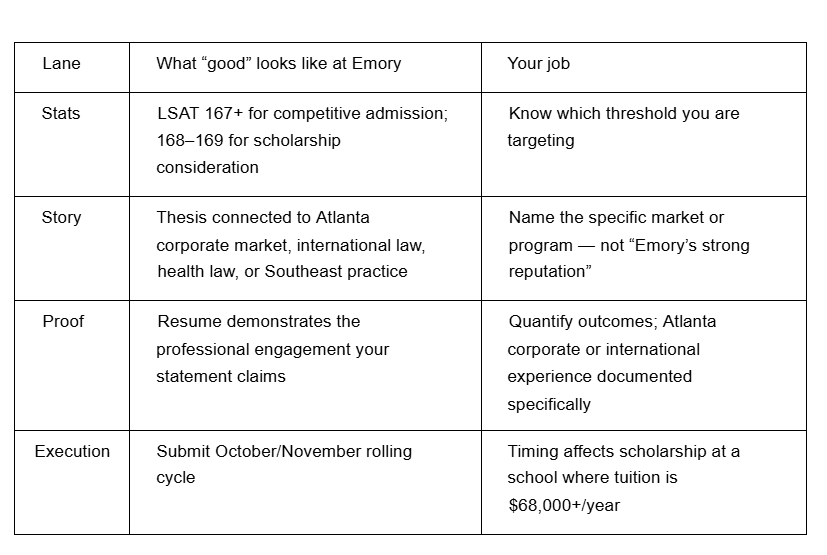
To get into Emory Law School, target a 167 LSAT and submit early in the rolling cycle. Emory’s 30.1% acceptance rate reflects a large class and a broad applicant pool — but scholarship competition is tighter than the acceptance rate suggests. Program alignment to Emory’s Atlanta corporate market, international law curriculum, or health law specialization is the variable that separates admission from meaningful merit aid.
Your Emory Law Scorecard
Setup: Emory Law in Numbers
What the Numbers Actually Mean
A 30.1% acceptance rate sounds generous. What it actually reflects is a large class — 391 students — relative to 3,931 applications. Emory is not a school that admits broadly; it is a school that admits a larger class than most T25 schools. The admitted applicant pool is genuinely competitive.
28% BigLaw placement from a school ranked #24 requires explanation. The explanation is Atlanta. Atlanta is the legal hub of the American South — home to the Atlanta offices of every major national law firm, the headquarters legal departments of Fortune 500 companies including Coca-Cola, Delta, Home Depot, UPS, and NCR, and a rapidly growing tech sector that generates increasing IP, privacy, and corporate legal work. Emory graduates feed that market with 50-year alumni relationships that no other law school in the Southeast can match.
391 students per class is large for a T25 school. The larger class size creates a wider alumni network than the school’s ranking suggests — Emory graduates are throughout Atlanta’s legal establishment in volume, not just at the top. That breadth creates career pathways for graduates across practice areas and career levels in ways that a smaller school’s alumni network does not.
The GPA spread is wide. A 3.51–3.90 interquartile range gives the committee significant flexibility. A 3.55 GPA with a 169 LSAT and specific Atlanta market alignment is a competitive Emory application. The wide GPA range reflects a deliberate admissions philosophy that weights the full file, not just the numbers.
$68,000/year tuition makes scholarship the primary financial planning variable. At this tuition level, the scholarship question is not optimization — it is a threshold question about career path sustainability. A 28% BigLaw placement rate means more than a quarter of Emory graduates enter the income tier where sticker is financially manageable. For the other 72%, scholarship or PSLF matters.
What Emory Is Actually Selecting For
Emory Law’s admissions process evaluates academic achievement, professional goals, and personal background. The school’s identity — cosmopolitan, Atlanta-rooted, with distinctive strengths in international law and health law — shapes what the committee values.
Academic preparation is primary. LSAT and GPA carry significant weight. The 30.1% acceptance rate from 3,931 competitive applications means the committee is not accepting all qualified applicants.
Atlanta market awareness. Emory’s committee responds to applications that demonstrate awareness of what Atlanta’s legal market is — not just that Atlanta is a major city, but specifically what industries generate legal work there, what firms dominate the market, and how Emory’s alumni network positions graduates for those specific opportunities. Applications that treat Emory as a generic T25 option miss the most important specific argument available.
International law orientation. Emory’s international law program is one of the strongest in the T25. The school’s Barton Child Law and Policy Center, its international arbitration curriculum, and its alumni network in international organizations and multinational firm practice create specific career pathways for applicants with international backgrounds or ambitions. Applications that engage this program specifically are making a school-specific argument most applicants skip.
Health law. Emory is located in Atlanta — headquarters of the CDC, one of the largest public health research and regulatory institutions in the world. The school’s health law program and its alumni in healthcare institutions, pharmaceutical companies, and public health organizations create a health law pipeline that no other T25 school replicates.
RULE
Emory’s committee is building a class for a school with specific geographic and programmatic strengths. Applications that name Atlanta’s corporate legal market, Emory’s international law program, or the health law curriculum with a backward connection to documented prior work are making arguments the committee responds to. Applications that describe Emory as “a leading law school with strong faculty and career placement” are making an argument the committee has read 3,931 times already.
The LSAT Score You Actually Need
The Vanderbilt comparison. Vanderbilt (170 median) and Notre Dame (170 median) are both above Emory’s 167 median. Applicants with 170+ LSAT scores who are choosing between Emory with significant scholarship and Vanderbilt at modest scholarship are making a real financial comparison. Emory uses merit aid aggressively to retain those applicants — which means above-median LSAT applicants who submit early have real scholarship leverage at Emory.
The retake calculation. The gap between a 166 and a 169 at Emory is not just an admissions probability gap. It is the gap between being at the median and being clearly above it at a school where scholarship money concentrates above the median. At $68,000/year tuition, a $20,000/year scholarship award is worth $60,000 over three years. The retake investment is financially justified at Emory for applicants in the 165– 167 range.
RULE
Emory’s acceptance rate of 30.1% creates a false sense of security for applicants with 167 LSAT scores. Getting in and getting funded are different problems requiring different LSAT targets. Know which problem you are solving before you set your preparation target.
GPA Damage Control
Emory’s wide 3.51–3.90 interquartile range creates real flexibility for applicants across a broad GPA distribution.
3.51–3.65 GPA: You are near the 25th percentile. A strong LSAT (169+) with specific program alignment and proof density makes you a competitive Emory application. A brief addendum addressing any specific anomalies is appropriate.
Below 3.51 GPA: The LSAT carries the academic argument. A 170+ LSAT with a below 25th-percentile GPA is a splitter application that Emory will consider but not at scholarship priority. Proof density and professional achievement become the compensating factors.
The international background consideration. Emory’s international law program means the committee has experience evaluating transcripts from non-US institutions. If your undergraduate education was outside the US, your transcript context — institutional ranking, grading scale, academic culture — should be briefly addressed in your application.
Upward trend. A strong final two years after a difficult early academic period registers as a meaningful signal. Address it in a one-paragraph addendum.
The Application Components That Move the Needle
Personal statement. The Emory personal statement that works names one of four specific things and connects it to documented prior work: Atlanta’s corporate legal market with a specific industry or firm target, Emory’s international law program with a specific international background or career goal, the health law and CDC-adjacent public health legal field, or a specific Emory program or faculty member whose work connects directly to the applicant’s career thesis.
The Emory-specific bridges that produce results:
Atlanta BigLaw and corporate law — King & Spalding, Alston & Bird, Troutman Pepper, Nelson Mullins — these are Atlanta-based firms with national and international practices and deep Emory alumni populations. Applicants who name the Atlanta BigLaw market, name specific firms, and connect Emory’s OCI pipeline to a specific career target are making the highest-signal school-specific argument available.
Fortune 500 in-house counsel — Coca-Cola, Delta, Home Depot, UPS, NCR, and the Atlanta operations of dozens of national corporations have large in-house legal departments with Emory alumni. The in-house counsel pathway at Emory is less discussed than BigLaw but equally well-documented. Applicants with business backgrounds targeting corporate legal departments have a specific Emory argument.
International law and arbitration — Emory’s international law curriculum and its alumni in international arbitration, multinational firm international practices, and international organizations create a specific career pathway for applicants with international backgrounds. Name the specific program element, the specific career target, and the specific Emory alumni network that connects them.
Health law and CDC — The Centers for Disease Control and Prevention, headquartered in Atlanta, is one of the most significant public health regulatory institutions in the world. Emory’s health law program and its alumni in CDC, FDA, pharmaceutical companies, and health system legal departments create a health law pipeline that no other T25 school can match for applicants targeting that specific career. An applicant with a public health background who names the CDC connection explicitly is making an argument that is both accurate and completely unused by most Emory applicants.
INSIGHT
The most underused Emory personal statement angle is the CDC and health law thesis. Emory is the only T25 law school located in the same city as one of the most consequential public health regulatory agencies in the world. Emory’s health law alumni are throughout CDC, the Georgia Department of Public Health, Emory Healthcare’s legal department, and Atlanta’s pharmaceutical and biotech sector legal teams. An applicant with public health, biology, or healthcare background who connects that background to Emory’s health law curriculum and the CDC proximity is making an argument the committee has seen rarely and that is entirely accurate. That combination — accurate, specific, and rare — is the best personal statement argument available.
Letters of recommendation. Two letters required. For Atlanta corporate-track applicants, a letter from a business or corporate supervisor who can speak to analytical capacity and the connection between professional work and legal practice is relevant. For international law applicants, a letter from an international organization, multinational company, or academic supervisor with international research context strengthens the program alignment argument.
Resume. Lead with outcomes and institutional context. Emory’s committee reads resumes for professional credibility and specific expertise — the background that makes the legal career thesis plausible. Quantify outcomes and name the institutions.
Application Timeline Strategy
Emory runs rolling admissions. With 3,931 applications and a 30.1% acceptance rate, the committee processes high volume efficiently.
The October imperative at Emory. At $68,000/year tuition, the scholarship timing effect has significant dollar consequences. Emory competes with Vanderbilt, Notre Dame, and Wake Forest for applicants in the 167–170 LSAT range. Merit aid is the primary yield competition tool. October-submitted files from competitive applicants receive scholarship consideration when the budget is fullest.
What to Do If You’re Waitlisted
Emory’s waitlist is active. The committee uses it to manage class size and fill specific profile gaps.
A strong Emory LOCI confirms first-choice interest, provides a substantive update, and reinforces the Atlanta market or program-specific argument. New LSAT scores above the median, new professional credentials in Atlanta-relevant fields, and demonstrated first-choice commitment are the most effective LOCI elements.
The Emory ROI Case
Emory’s combination of $68,000/year tuition, 28% BigLaw placement, and Atlanta market dominance creates an ROI profile that works for specific career paths with scholarship aid.
The BigLaw scenario with scholarship: A scholarship-adjusted net cost of $45,000– $50,000/year at Emory. Three-year tuition debt of $135,000–$150,000. Atlanta BigLaw starting salary at King & Spalding or Alston & Bird: $215,000. Monthly 10-year payment: approximately $1,568–$1,742. That is manageable at BigLaw compensation rates.
The public interest scenario: Requires significant scholarship ($30,000+/year) and PSLF eligibility. At $38,000/year net tuition with a $30,000 scholarship, three-year tuition debt of $114,000. Government salary of $72,000 produces a monthly income based payment of approximately $700 — manageable with PSLF.
Lovare’s Take on Emory Law
Emory is the most strategically underpositioned school in the T25 for applicants with Atlanta career targets. Its 28% BigLaw placement, Fortune 500 in-house counsel network, CDC health law pipeline, and international law program create a value proposition that is genuinely differentiated from every other school in its ranking tier.
The applicants who win at Emory are the ones who stopped treating it as a Georgetown safety and started treating it as the deepest law school alumni network in the fastest growing major legal market in the country. They named King & Spalding or the CDC in their personal statement. They submitted in October. They understood that Atlanta is not a consolation prize — it is a career destination.
→ Take the Lovare Diagnostic to find out where your LSAT stands relative to Emory’s scholarship floor.
Common Mistakes
Treating Emory as a Georgetown safety. The application that lands at Georgetown does not land at Emory. The committees want different things.
Not naming Atlanta specifically. The fifth-largest metropolitan area in the US has a legal market that Emory dominates. Most applications do not acknowledge this explicitly.
Ignoring the CDC health law angle. The most differentiated and underused Emory application argument is sitting one mile from the law school.
Submitting in January when the file was ready in October. At $68,000/year tuition, rolling scholarship allocation has significant dollar consequences.
Not comparing net cost against Vanderbilt and Notre Dame. Emory frequently offers competitive applicants more scholarship money than either of those schools. Run the comparison before you assume rank hierarchy equals financial hierarchy.
If You Only Do 3 Things
1. Name Atlanta’s legal market or Emory’s specific programs in your personal statement. Connect it to documented prior work. That connection is the difference between a generic T25 application and an Emory-specific one.
2. Submit in October. Rolling scholarship allocation at $68,000/year tuition means October submission is a financial decision. A complete, strong file in October competes for a full budget.
3. Target 168–169, not 167. One to two points above median at Emory is the scholarship floor. Know which goal you are preparing for before you set your timeline.
FAQs
Questions answered so you can get started quickly.
What does Arizona State Sandra Day O'Connor College of Law look for in personal statements?
Arizona State Sandra Day O'Connor College of Law reads for Arizona market ties
What does Berkeley Law look for in personal statements?
Berkeley Law reads for public interest
What does Boston College Law School look for in personal statements?
Boston College Law School reads for BC's Jesuit mission
What does Boston University School of Law look for in personal statements?
Boston University School of Law reads for IP
What does Columbia Law School look for in personal statements?
Columbia Law School reads for specific New York market ambitions and Columbia's cross-disciplinary strengths (business law
What does Cornell Law School look for in personal statements?
Cornell Law School reads for Cornell's tight-knit Ivy League community
What does Duke Law School look for in personal statements?
Duke Law School reads for Duke's leadership-focused culture
What does Emory Law School look for in personal statements?
Emory Law School reads for Atlanta market
What does Fordham Law School look for in personal statements?
Fordham Law School reads for New York market connection
What does Georgetown Law look for in personal statements?
Georgetown Law reads for DC policy
What does GWU Law School look for in personal statements?
GWU Law School reads for government
What does Harvard Law School look for in personal statements?
Harvard Law School reads for intellectual leadership and a vision for using law to solve a problem at scale. The most common failure in personal statements is generality — statements that could describe any top law school and any applicant with a law-adjacent interest. The committee at Harvard Law School has read thousands of such statements. The personal statements that generate admissions decisions are specific enough to be falsifiable: they name a problem
What does Northwestern Pritzker School of Law look for in personal statements?
Northwestern Pritzker School of Law reads for Northwestern's strong preference for work experience
What does Notre Dame Law School look for in personal statements?
Notre Dame Law School reads for values alignment
What does NYU School of Law look for in personal statements?
NYU School of Law reads for global law
What does Ohio State Moritz College of Law look for in personal statements?
Ohio State Moritz College of Law reads for Ohio/Midwest market ties
What does Stanford Law School look for in personal statements?
Stanford Law School reads for intellectual distinctiveness
What does UC Davis School of Law look for in personal statements?
UC Davis School of Law reads for California market ties
What does UC Irvine School of Law look for in personal statements?
UC Irvine School of Law reads for California market ambitions
What does UCLA School of Law look for in personal statements?
UCLA School of Law reads for California market connections
What does University of Chicago Law School look for in personal statements?
University of Chicago Law School reads for law and economics methodology
What does University of Michigan Law School look for in personal statements?
University of Michigan Law School reads for Michigan's collaborative culture
What does University of Minnesota Law School look for in personal statements?
University of Minnesota Law School reads for Minnesota market ties
What does University of Pennsylvania Carey Law School look for in personal statements?
University of Pennsylvania Carey Law School reads for Penn's Wharton and business school connections
What does University of Texas School of Law look for in personal statements?
University of Texas School of Law reads for Texas market ties
What does University of Virginia School of Law look for in personal statements?
University of Virginia School of Law reads for UVA's community-focused culture
What does USC Gould School of Law look for in personal statements?
USC Gould School of Law reads for LA market ties
What does Vanderbilt Law School look for in personal statements?
Vanderbilt Law School reads for Vanderbilt's Nashville market access
What does Wake Forest University School of Law look for in personal statements?
Wake Forest University School of Law reads for Wake Forest's small community
What does Washington University in St. Louis School of Law look for in personal statements?
Washington University in St. Louis School of Law reads for WashU's strong scholarship program
What does Yale Law School look for in personal statements?
Yale Law School reads for original legal thinking
Who can use the Playbooks?
Our Playbooks are designed for students, professionals, and anyone looking to enhance their skills in the specific topic area.
Are the Playbooks updated regularly?
Absolutely — we review and update our Playbooks periodically to ensure the content stays relevant and accurate.
How does Arizona State Sandra Day O'Connor College of Law's waitlist work?
Arizona State Sandra Day O'Connor College of Law's waitlist — moderate movement"; ASU's rolling admissions process and in-state/out-of-state pricing creates some yield variability; waitlist activity is higher for out-of-state applicants. The most effective waitlist strategy has three components: (1) a Letter of Continued Interest (LOCI) submitted promptly after being waitlisted
How does Berkeley Law's waitlist work?
Berkeley Law's waitlist — active in most cycles"; Berkeley's mission-driven applicant pool creates yield variability; a LOCI that demonstrates genuine public interest commitment rather than generic enthusiasm performs best. The most effective waitlist strategy has three components: (1) a Letter of Continued Interest submitted promptly after being waitlisted
How does Boston College Law School's waitlist work?
Boston College Law School's waitlist — active in most cycles"; BC's acceptance rate of 8.5% masks significant waitlist movement; demonstrated first-choice interest is weighed. The most effective waitlist strategy has three components: (1) a Letter of Continued Interest (LOCI) submitted promptly after being waitlisted
How does Boston University School of Law's waitlist work?
Boston University School of Law's waitlist — active waitlist — BU uses it to manage yield from a large aspirational pool"; a strong LOCI with first-choice commitment and updated credentials moves. The most effective waitlist strategy has three components: (1) a Letter of Continued Interest (LOCI) submitted promptly after being waitlisted
How does Columbia Law School's waitlist work?
Columbia Law School's waitlist — moderately active"; Columbia's high yield means limited waitlist movement most years; update with new LSAT or publications. The most effective waitlist strategy has three components: (1) a Letter of Continued Interest (LOCI) submitted promptly after being waitlisted
How does Cornell Law School's waitlist work?
Cornell Law School's waitlist — moderate activity"; Cornell's smaller class creates some waitlist movement; demonstrated first-choice preference and updated credentials are the key variables. The most effective waitlist strategy has three components: (1) a Letter of Continued Interest submitted promptly after being waitlisted
How does Duke Law School's waitlist work?
Duke Law School's waitlist — moderate movement"; Duke's yield from a national applicant pool creates some waitlist variability; a LOCI with updated LSAT and Duke-specific program reasoning performs well. The most effective waitlist strategy has three components: (1) a Letter of Continued Interest submitted promptly after being waitlisted
How does Emory Law School's waitlist work?
Emory Law School's waitlist — moderately active"; Emory's broad applicant pool creates some waitlist movement; an updated LSAT or strong LOCI citing Atlanta-specific career goals helps. The most effective waitlist strategy has three components: (1) a Letter of Continued Interest (LOCI) submitted promptly after being waitlisted
How does Fordham Law School's waitlist work?
Fordham Law School's waitlist — active — Fordham's acceptance rate of 16.2% is tighter than it appears"; the waitlist moves regularly; demonstrated first-choice commitment strengthens LOCI. The most effective waitlist strategy has three components: (1) a Letter of Continued Interest (LOCI) submitted promptly after being waitlisted
How does Georgetown Law's waitlist work?
Georgetown Law's waitlist — one of the most active waitlists in T14 — Georgetown enrolls a very large class and pulls from the waitlist regularly. The most effective waitlist strategy has three components: (1) a Letter of Continued Interest (LOCI) submitted promptly after being waitlisted
How does GWU Law School's waitlist work?
GWU Law School's waitlist — active waitlist — GWU's large class and rolling admissions process means meaningful waitlist movement most cycles. The most effective waitlist strategy has three components: (1) a Letter of Continued Interest (LOCI) submitted promptly after being waitlisted
How does Harvard Law School's waitlist work?
Harvard Law School's waitlist — rarely moves significantly"; most admitted candidates enroll. The most effective waitlist strategy has three components: (1) a Letter of Continued Interest (LOCI) submitted promptly after being waitlisted
How does Northwestern Pritzker School of Law's waitlist work?
Northwestern Pritzker School of Law's waitlist — active in most cycles"; Northwestern's professional-experience preference creates yield variability; a LOCI that emphasizes career development since application submission is particularly effective here. The most effective waitlist strategy has three components: (1) a Letter of Continued Interest submitted promptly after being waitlisted
How does Notre Dame Law School's waitlist work?
Notre Dame Law School's waitlist — moderate activity"; Notre Dame's community focus means demonstrated interest and a strong statement of why Notre Dame specifically can move waitlisted applicants. The most effective waitlist strategy has three components: (1) a Letter of Continued Interest (LOCI) submitted promptly after being waitlisted
How does NYU School of Law's waitlist work?
NYU School of Law's waitlist — moderately active"; NYU's high yield means most years see modest waitlist movement; public interest applicants sometimes have an edge. The most effective waitlist strategy has three components: (1) a Letter of Continued Interest (LOCI) submitted promptly after being waitlisted
How does Ohio State Moritz College of Law's waitlist work?
Ohio State Moritz College of Law's waitlist — moderate movement"; in-state applicants on the waitlist have a meaningful advantage; an LOCI demonstrating Ohio career intent and first-choice preference is the key variable. The most effective waitlist strategy has three components: (1) a Letter of Continued Interest (LOCI) submitted promptly after being waitlisted
How does Stanford Law School's waitlist work?
Stanford Law School's waitlist — rarely moves significantly"; Stanford's yield is exceptionally high; waitlisted applicants should submit a LOCI but temper expectations — most Stanford waitlist years see minimal movement. The most effective waitlist strategy has three components: (1) a Letter of Continued Interest submitted promptly after being waitlisted
How does UC Davis School of Law's waitlist work?
UC Davis School of Law's waitlist — moderate activity"; UC Davis's California applicant volume creates some waitlist movement; demonstrated California career intent and first-choice preference are the key LOCI variables. The most effective waitlist strategy has three components: (1) a Letter of Continued Interest submitted promptly after being waitlisted
How does UC Irvine School of Law's waitlist work?
UC Irvine School of Law's waitlist — moderate to active — UCI's small class and California applicant volume create waitlist movement most cycles"; demonstrated California career commitment strengthens the LOCI. The most effective waitlist strategy has three components: (1) a Letter of Continued Interest (LOCI) submitted promptly after being waitlisted
How does UCLA School of Law's waitlist work?
UCLA School of Law's waitlist — active in most cycles"; UCLA's large California applicant pool and in-state preference creates meaningful waitlist movement; demonstrating California career commitment and first-choice preference strengthens the LOCI. The most effective waitlist strategy has three components: (1) a Letter of Continued Interest submitted promptly after being waitlisted
How does University of Chicago Law School's waitlist work?
University of Chicago Law School's waitlist — moderate movement"; UChicago's high yield from a self-selected intellectually serious applicant pool limits waitlist activity; a LOCI that demonstrates genuine engagement with law and economics scholarship is the best differentiator. The most effective waitlist strategy has three components: (1) a Letter of Continued Interest submitted promptly after being waitlisted
How does University of Michigan Law School's waitlist work?
University of Michigan Law School's waitlist — active in most cycles"; Michigan's large national applicant pool creates real waitlist movement; demonstrated first-choice commitment with Michigan-specific program reasoning performs well in LOCI letters. The most effective waitlist strategy has three components: (1) a Letter of Continued Interest submitted promptly after being waitlisted
How does University of Minnesota Law School's waitlist work?
University of Minnesota Law School's waitlist — moderate movement"; Minnesota's in-state preference creates some yield variability; demonstrated Minnesota career intent and first-choice preference are the most effective LOCI variables. The most effective waitlist strategy has three components: (1) a Letter of Continued Interest submitted promptly after being waitlisted
How does University of Pennsylvania Carey Law School's waitlist work?
University of Pennsylvania Carey Law School's waitlist — moderate to low activity"; Penn's yield from a highly self-selected applicant pool limits waitlist movement; a LOCI demonstrating genuine Penn-Wharton interdisciplinary interest is more effective than generic first-choice statements. The most effective waitlist strategy has three components: (1) a Letter of Continued Interest submitted promptly after being waitlisted
How does University of Texas School of Law's waitlist work?
University of Texas School of Law's waitlist — active in most cycles"; UT's in-state preference creates yield variability for out-of-state applicants; demonstrated Texas career intent is the most important LOCI variable. The most effective waitlist strategy has three components: (1) a Letter of Continued Interest submitted promptly after being waitlisted
How does University of Virginia School of Law's waitlist work?
University of Virginia School of Law's waitlist — moderate activity"; UVA's community-focused culture means demonstrated genuine interest and fit carry more weight in LOCI letters than updated credentials alone. The most effective waitlist strategy has three components: (1) a Letter of Continued Interest submitted promptly after being waitlisted
How does USC Gould School of Law's waitlist work?
USC Gould School of Law's waitlist — moderately active"; USC's yield relative to UCLA creates some waitlist variability; applicants waitlisted at USC while admitted at UCLA can use the UCLA offer in a LOCI to prompt scholarship consideration. The most effective waitlist strategy has three components: (1) a Letter of Continued Interest submitted promptly after being waitlisted
How does Vanderbilt Law School's waitlist work?
Vanderbilt Law School's waitlist — active in most cycles"; Vanderbilt's scholarship-driven yield creates meaningful waitlist movement; a competing offer from a peer school mentioned in a LOCI can prompt both admission and scholarship consideration. The most effective waitlist strategy has three components: (1) a Letter of Continued Interest submitted promptly after being waitlisted
How does Wake Forest University School of Law's waitlist work?
Wake Forest University School of Law's waitlist — active in most cycles"; Wake Forest's smaller class creates more waitlist variability; a personal
How does Washington University in St. Louis School of Law's waitlist work?
Washington University in St. Louis School of Law's waitlist — active in most cycles"; WashU's scholarship-driven yield creates real waitlist movement; a LOCI that demonstrates genuine first-choice preference with WashU-specific program reasoning
How does Yale Law School's waitlist work?
Yale Law School's waitlist — highly selective"; some movement in strong yield years; a compelling LOCI with new credentials is the best lever. The most effective waitlist strategy has three components: (1) a Letter of Continued Interest (LOCI) submitted promptly after being waitlisted
How many tutoring sessions will I need to improve my LSAT score?
The number of sessions varies depending on your starting score, target score, and how much time you have before your test date. During an initial consultation, your tutor will assess your current level and recommend a study plan. Most students see meaningful improvement within 8–12 sessions of consistent, focused practice.
Does Arizona State Sandra Day O'Connor College of Law offer merit scholarships?
Arizona State Sandra Day O'Connor College of Law offers competitive merit scholarships for both in-state and out-of-state applicants; LSAT 164+ is typically the threshold for merit consideration. The most important scholarship strategy variable is application timing — schools that run rolling admissions reward Early Action or Early Decision submissions with stronger packages because scholarship pools are fuller in the fall. Scholarship negotiation is also a real lever: if a peer school (similar ranking
Does Berkeley Law offer merit scholarships?
Berkeley Law offers merit scholarships"; Berkeley's in-state tuition makes scholarship dollars go further;" LSAT 171+ with demonstrated public interest credentials creates strong leverage. The most important scholarship strategy variable is application timing — schools that run rolling admissions reward Early Action or Early Decision submissions with stronger packages because scholarship pools are fuller in the fall. Scholarship negotiation is also a real lever: if a peer school offers you a meaningfully better package
Does Boston College Law School offer merit scholarships?
Boston College Law School offers merit scholarships"; BC's relatively lower tuition compared to peers means scholarships stretch further;" LSAT 170+ increases merit consideration. The most important scholarship strategy variable is application timing — schools that run rolling admissions reward Early Action or Early Decision submissions with stronger packages because scholarship pools are fuller in the fall. Scholarship negotiation is also a real lever: if a peer school (similar ranking
Does Boston University School of Law offer merit scholarships?
Boston University School of Law offers merit scholarships"; LSAT 171+ puts you in scholarship consideration territory;" Early Action submission maximizes leverage. The most important scholarship strategy variable is application timing — schools that run rolling admissions reward Early Action or Early Decision submissions with stronger packages because scholarship pools are fuller in the fall. Scholarship negotiation is also a real lever: if a peer school (similar ranking
Does Columbia Law School offer merit scholarships?
Columbia Law School offers limited merit scholarships"; most financial aid is need-based;" admitted applicants with LSAT 174+ can negotiate merit aid. The most important scholarship strategy variable is application timing — schools that run rolling admissions reward Early Action or Early Decision submissions with stronger packages because scholarship pools are fuller in the fall. Scholarship negotiation is also a real lever: if a peer school (similar ranking
Does Cornell Law School offer merit scholarships?
Cornell Law School offers merit scholarships"; LSAT 172+ creates meaningful scholarship leverage;" Cornell competes aggressively for high-LSAT applicants against peer Ivies. The most important scholarship strategy variable is application timing — schools that run rolling admissions reward Early Action or Early Decision submissions with stronger packages because scholarship pools are fuller in the fall. Scholarship negotiation is also a real lever: if a peer school offers you a meaningfully better package
Does Duke Law School offer merit scholarships?
Duke Law School offers merit scholarships"; LSAT 171+ is the threshold for significant consideration;" Duke actively competes for high-LSAT applicants with Georgetown and Notre Dame. The most important scholarship strategy variable is application timing — schools that run rolling admissions reward Early Action or Early Decision submissions with stronger packages because scholarship pools are fuller in the fall. Scholarship negotiation is also a real lever: if a peer school offers you a meaningfully better package
Does Emory Law School offer merit scholarships?
Emory Law School offers merit scholarships"; LSAT 168+ with a strong GPA creates meaningful leverage;" Emory competes aggressively for high-LSAT applicants with scholarship offers. The most important scholarship strategy variable is application timing — schools that run rolling admissions reward Early Action or Early Decision submissions with stronger packages because scholarship pools are fuller in the fall. Scholarship negotiation is also a real lever: if a peer school (similar ranking
Does Fordham Law School offer merit scholarships?
Fordham Law School offers merit scholarships"; Fordham's New York placement competes with higher-ranked schools;" LSAT 168+ typically qualifies for meaningful merit consideration. The most important scholarship strategy variable is application timing — schools that run rolling admissions reward Early Action or Early Decision submissions with stronger packages because scholarship pools are fuller in the fall. Scholarship negotiation is also a real lever: if a peer school (similar ranking
Does Georgetown Law offer merit scholarships?
Georgetown Law offers merit scholarships"; the Dean's Scholarship is competitive;" applicants with LSAT 172+ have meaningful leverage. The most important scholarship strategy variable is application timing — schools that run rolling admissions reward Early Action or Early Decision submissions with stronger packages because scholarship pools are fuller in the fall. Scholarship negotiation is also a real lever: if a peer school (similar ranking
Does GWU Law School offer merit scholarships?
GWU Law School offers merit scholarships"; LSAT 169+ is typically required for significant consideration;" Early Decision applicants often receive stronger packages. The most important scholarship strategy variable is application timing — schools that run rolling admissions reward Early Action or Early Decision submissions with stronger packages because scholarship pools are fuller in the fall. Scholarship negotiation is also a real lever: if a peer school (similar ranking
Does Harvard Law School offer merit scholarships?
Harvard Law School does not offer merit scholarships — all aid is need-based through its generous LRAP program. The most important scholarship strategy variable is application timing — schools that run rolling admissions reward Early Action or Early Decision submissions with stronger packages because scholarship pools are fuller in the fall. Scholarship negotiation is also a real lever: if a peer school (similar ranking
Does Northwestern Pritzker School of Law offer merit scholarships?
Northwestern Pritzker School of Law offers merit scholarships"; LSAT 172+ with strong professional experience creates meaningful leverage;" Northwestern's work-experience preference sometimes benefits applicants with below-median LSATs who have exceptional careers. The most important scholarship strategy variable is application timing — schools that run rolling admissions reward Early Action or Early Decision submissions with stronger packages because scholarship pools are fuller in the fall. Scholarship negotiation is also a real lever: if a peer school offers you a meaningfully better package
Does Notre Dame Law School offer merit scholarships?
Notre Dame Law School offers competitive merit scholarships; strong LSAT scores above 170 typically qualify for significant merit aid. The most important scholarship strategy variable is application timing — schools that run rolling admissions reward Early Action or Early Decision submissions with stronger packages because scholarship pools are fuller in the fall. Scholarship negotiation is also a real lever: if a peer school (similar ranking
Does NYU School of Law offer merit scholarships?
NYU School of Law offers the Furman Academic Scholarship (full tuition) and Root-Tilden-Kern (public interest full tuition); both are competitive but life-changing. The most important scholarship strategy variable is application timing — schools that run rolling admissions reward Early Action or Early Decision submissions with stronger packages because scholarship pools are fuller in the fall. Scholarship negotiation is also a real lever: if a peer school (similar ranking
Does Ohio State Moritz College of Law offer merit scholarships?
Ohio State Moritz College of Law strong merit scholarship program
Does Stanford Law School offer merit scholarships?
Stanford Law School does not offer merit scholarships — all aid is need-based"; Stanford's LRAP is generous for public interest graduates;" financial strategy should account for need-based aid rather than merit negotiation. The most important scholarship strategy variable is application timing — schools that run rolling admissions reward Early Action or Early Decision submissions with stronger packages because scholarship pools are fuller in the fall. Scholarship negotiation is also a real lever: if a peer school offers you a meaningfully better package
Does UC Davis School of Law offer merit scholarships?
UC Davis School of Law offers merit scholarships"; UC Davis's in-state tuition makes scholarship dollars highly effective;" LSAT 166+ creates meaningful leverage for both in-state and out-of-state applicants. The most important scholarship strategy variable is application timing — schools that run rolling admissions reward Early Action or Early Decision submissions with stronger packages because scholarship pools are fuller in the fall. Scholarship negotiation is also a real lever: if a peer school offers you a meaningfully better package
Does UC Irvine School of Law offer merit scholarships?
UC Irvine School of Law offers merit scholarships
Does UCLA School of Law offer merit scholarships?
UCLA School of Law offers merit scholarships"; LSAT 171+ with a strong GPA creates meaningful leverage;" UCLA's in-state tuition advantage means scholarships stretch significantly further than at private peers. The most important scholarship strategy variable is application timing — schools that run rolling admissions reward Early Action or Early Decision submissions with stronger packages because scholarship pools are fuller in the fall. Scholarship negotiation is also a real lever: if a peer school offers you a meaningfully better package
Does University of Chicago Law School offer merit scholarships?
University of Chicago Law School offers merit scholarships"; LSAT 174+ creates meaningful leverage;" UChicago competes for top applicants against Columbia and NYU with scholarship offers. The most important scholarship strategy variable is application timing — schools that run rolling admissions reward Early Action or Early Decision submissions with stronger packages because scholarship pools are fuller in the fall. Scholarship negotiation is also a real lever: if a peer school offers you a meaningfully better package
Does University of Michigan Law School offer merit scholarships?
University of Michigan Law School offers merit scholarships"; LSAT 172+ creates meaningful consideration;" Michigan uses scholarship offers to compete with peer schools for strong out-of-state applicants. The most important scholarship strategy variable is application timing — schools that run rolling admissions reward Early Action or Early Decision submissions with stronger packages because scholarship pools are fuller in the fall. Scholarship negotiation is also a real lever: if a peer school offers you a meaningfully better package
Does University of Minnesota Law School offer merit scholarships?
University of Minnesota Law School strong merit scholarship program"; Minnesota's in-state tuition makes it one of the highest-value T1 options in the Midwest;" LSAT 165+ creates meaningful scholarship consideration. The most important scholarship strategy variable is application timing — schools that run rolling admissions reward Early Action or Early Decision submissions with stronger packages because scholarship pools are fuller in the fall. Scholarship negotiation is also a real lever: if a peer school offers you a meaningfully better package
Does University of Pennsylvania Carey Law School offer merit scholarships?
University of Pennsylvania Carey Law School offers merit scholarships"; Penn's 9% acceptance rate means scholarship competition is intense;" LSAT 173+ creates meaningful leverage
Does University of Texas School of Law offer merit scholarships?
University of Texas School of Law highly competitive merit scholarships for both in-state and out-of-state applicants"; UT's in-state tuition makes it one of the highest-value T14 options;" LSAT 171+ creates strong scholarship leverage. The most important scholarship strategy variable is application timing — schools that run rolling admissions reward Early Action or Early Decision submissions with stronger packages because scholarship pools are fuller in the fall. Scholarship negotiation is also a real lever: if a peer school offers you a meaningfully better package
Does University of Virginia School of Law offer merit scholarships?
University of Virginia School of Law offers merit scholarships"; LSAT 172+ with strong GPA creates meaningful leverage;" UVA competes with Georgetown and Michigan for strong applicants using scholarship offers. The most important scholarship strategy variable is application timing — schools that run rolling admissions reward Early Action or Early Decision submissions with stronger packages because scholarship pools are fuller in the fall. Scholarship negotiation is also a real lever: if a peer school offers you a meaningfully better package
Does USC Gould School of Law offer merit scholarships?
USC Gould School of Law offers competitive merit scholarships"; USC uses scholarship offers aggressively to compete for high-LSAT applicants against UCLA;" LSAT 169+ creates real negotiating leverage with both schools simultaneously. The most important scholarship strategy variable is application timing — schools that run rolling admissions reward Early Action or Early Decision submissions with stronger packages because scholarship pools are fuller in the fall. Scholarship negotiation is also a real lever: if a peer school offers you a meaningfully better package
Does Vanderbilt Law School offer merit scholarships?
Vanderbilt Law School offers competitive merit scholarships"; Vanderbilt uses scholarship packages aggressively to compete for high-LSAT applicants;" LSAT 171+ creates real leverage
Does Wake Forest University School of Law offer merit scholarships?
Wake Forest University School of Law competitive merit scholarships available"; LSAT 164+ creates significant leverage;" Wake Forest actively uses scholarship offers to compete for high-LSAT applicants. The most important scholarship strategy variable is application timing — schools that run rolling admissions reward Early Action or Early Decision submissions with stronger packages because scholarship pools are fuller in the fall. Scholarship negotiation is also a real lever: if a peer school (similar ranking
Does Washington University in St. Louis School of Law offer merit scholarships?
Washington University in St. Louis School of Law one of the most aggressive scholarship programs in the T14"; LSAT 170+ frequently results in significant merit awards;" WashU is a legitimate value play against higher-ranked schools with no scholarship offers — model the net cost comparison carefully. The most important scholarship strategy variable is application timing — schools that run rolling admissions reward Early Action or Early Decision submissions with stronger packages because scholarship pools are fuller in the fall. Scholarship negotiation is also a real lever: if a peer school offers you a meaningfully better package
Does Yale Law School offer merit scholarships?
Yale Law School does not offer merit scholarships — 100% need-based aid; average grant covers most tuition for students with demonstrated need. The most important scholarship strategy variable is application timing — schools that run rolling admissions reward Early Action or Early Decision submissions with stronger packages because scholarship pools are fuller in the fall. Scholarship negotiation is also a real lever: if a peer school (similar ranking
.png)